Maximize Your Drive: Why Tire Rotation is Non-Negotiable

June 1st, 2026 by

For many drivers in Guntersville, AL, tires are often a ‘set it and forget it’ component—until something goes wrong. But if you want to protect your investment and ensure your safety on Highway 431, understanding the science of tire rotation is essential. Rotating your tires isn’t just a suggestion from your mechanic; it’s a critical maintenance task that balances the workload across all four wheels. Whether you’re hauling gear in a Shop New Chevrolet Silverado 1500 or commuting in a sleek SUV, the way your tires meet the Alabama asphalt changes based on their position. By moving them regularly, you aren’t just extending the life of the rubber; you’re preserving the handling characteristics that keep you in control during a sudden summer downpour or a tight turn on a backroad. At Guntersville Chevrolet, we believe an informed driver is a safer driver. In this guide, we’ll dive deep into why this simple service is the backbone of vehicle longevity and how it saves you significant money at the pump and the shop.
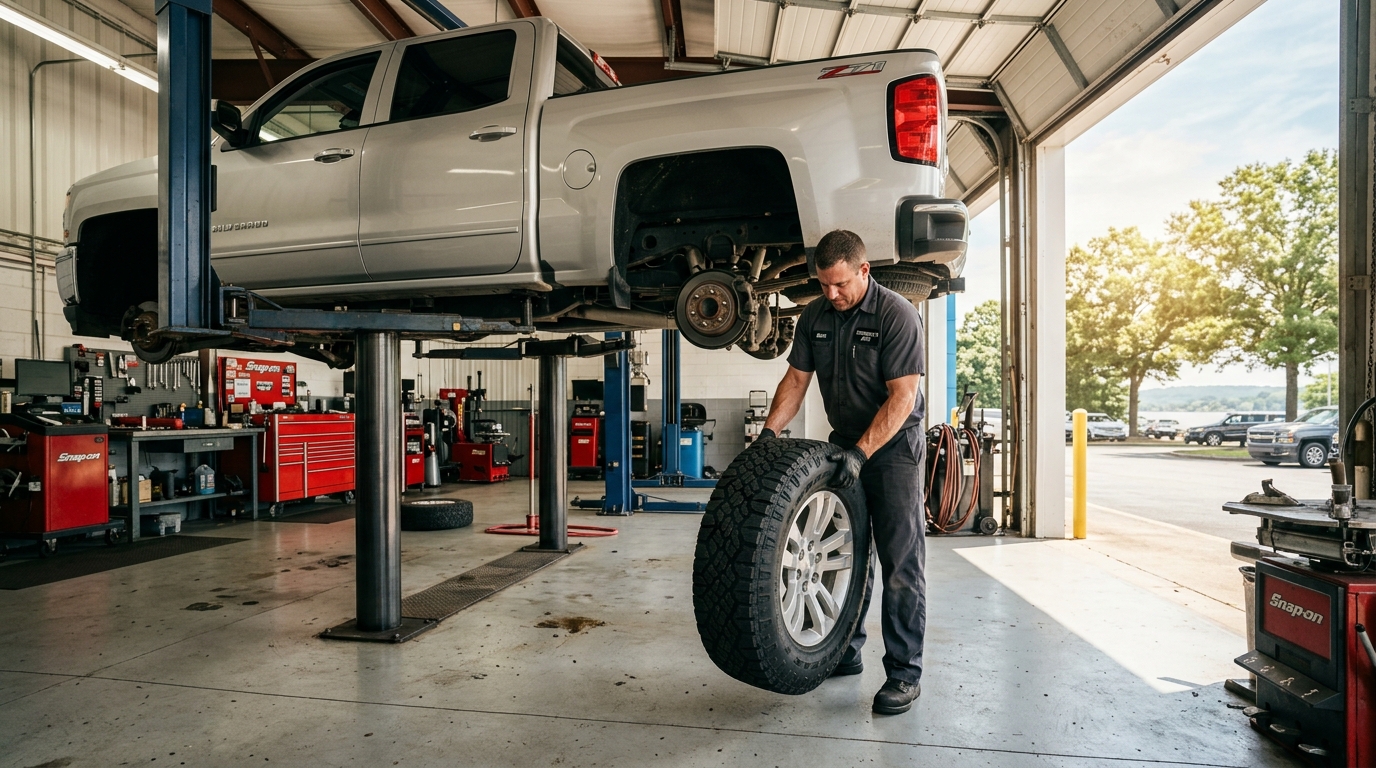
 

AI generated: Wide-angle professional shot, automotive service bay in Guntersville, Alabama, late May afternoon, bright late-spring sunlight streaming through open garage doors, a silver Chevrolet Silverado 1500 elevated on a hydraulic twin-post lift, focal point on a technician in a dark grey work uniform carefully rotating a large all-terrain tire, muscular forearms visible, focused expression, cinematic depth of field, background features organized tool chests and professional shop equipment, clean concrete floor with realistic oil stains, hazy late-spring atmosphere, soft blue sky visible through the bay door, lush green Alabama oak trees in the distance, warm and productive mood, realistic industrial lighting with natural sun flares, crisp details on tire tread and mechanical components, high-resolution photography style.

The Fundamentals: What Exactly is a Tire Rotation?


At its core, a tire rotation is the systematic practice of moving your wheels and tires from one position on the vehicle to another. It sounds simple, but the engineering behind it is quite specific. Depending on your vehicle’s drivetrain—whether it’s front-wheel drive (FWD), rear-wheel drive (RWD), or all-wheel drive (AWD)—each tire experiences different levels of friction, heat, and weight. Front tires, for instance, handle the majority of the steering forces and much of the braking load. In a FWD vehicle, they also provide the power to move the car forward. This means they wear down much faster than the rear tires. By swapping them, you ensure that the tread wears down at a uniform rate across the entire set.

Think of it like a pair of shoes. If you always walked on the outside edge of your soles, they would wear through in months. But if you could magically redistribute that wear across the entire bottom of the shoe, they would last years. Tire rotation does exactly that for your vehicle. For new vehicle owners who have just picked up a Shop New Chevrolet Trax, establishing this habit early is the best way to ensure you aren’t buying a new set of tires thousands of miles earlier than necessary.
 

The Three Pillars of Tire Longevity


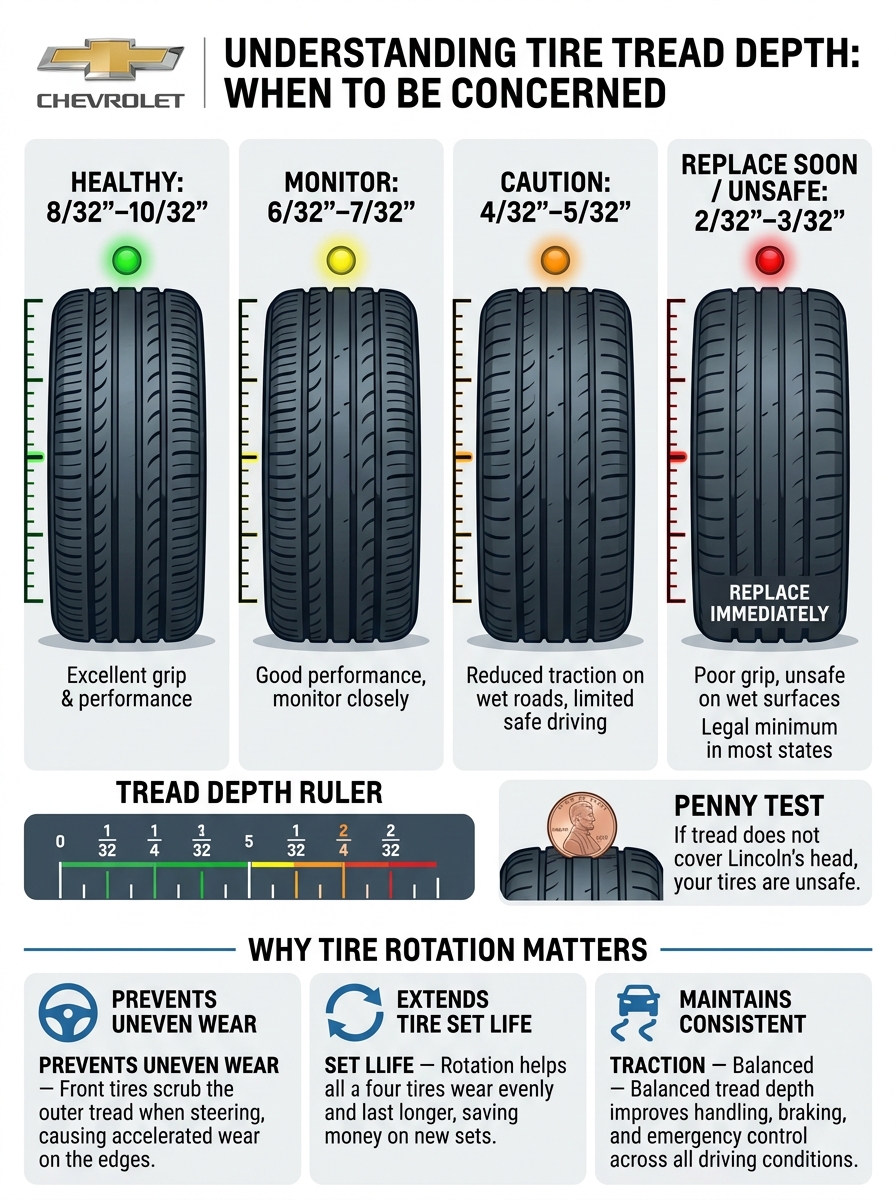
1. Preventing Uneven Tread Wear: Every time you turn the steering wheel, your front tires experience lateral force that scrubs the outer edges of the tread. Meanwhile, the rear tires mostly follow along. Over time, this creates a massive disparity in tread depth. Rotation resets this balance.

2. Extending Set Life: Tires are a major investment. A high-quality set for a truck like the Shop New Chevrolet Silverado HD can cost upwards of a thousand dollars. When you rotate them, you ensure all four tires reach the end of their usable life at the same time, allowing you to replace them as a matched set, which is better for your vehicle’s suspension and drivetrain.

3. Maintaining Optimal Traction: Tread is what allows your car to grip the road. If two tires are nearly bald while the others are fresh, your vehicle’s handling becomes unpredictable, especially in emergency maneuvers. Consistent rotation keeps the grip levels consistent across all four corners.


AI generated: Create a clean, professional automotive infographic explaining tire tread depth and when drivers should be concerned. Use a vertical layout with realistic tire tread illustrations, measurement markers, and clear warning zones. Show four tread-depth levels: “Healthy: 8/32”–10/32” with deep grooves and green indicator,” “Monitor: 6/32”–7/32” with slight wear and yellow indicator,” “Caution: 4/32”–5/32” with reduced wet traction and orange indicator,” and “Replace Soon / Unsafe: 2/32”–3/32” with shallow tread, red indicator, and legal-minimum warning.” Include a simple tread-depth ruler graphic and a small “penny test” visual. Add a section titled “Why Tire Rotation Matters” with three concise callouts: “Prevents Uneven Wear — front tires scrub the outer tread when steering,” “Extends Tire Set Life — rotation helps all four tires wear evenly and last longer,” and “Maintains Consistent Traction — balanced tread depth improves handling, braking, and emergency control.” Use icons for steering force, tire rotation arrows, traction grip, and replacement warning. Style should be modern dealership service-center design, easy to read, high contrast, white background, Chevrolet truck service theme, professional vector infographic, no clutter, no tiny unreadable text.

Safety on the Alabama Roads

Braking Distance


Uneven tread significantly increases the distance it takes to come to a full stop. In a town like Guntersville, where traffic on the bridge can stop suddenly, those extra few feet are the difference between a safe stop and a fender-bender.


Hydroplaning Risks


Tread grooves are designed to channel water away from the tire’s contact patch. If your tires are worn unevenly, they can’t effectively move water, causing the car to ‘float’ on the road surface during heavy Alabama rainstorms.


Blowout Prevention


Tires that aren’t rotated can develop ‘thin spots’ or excessive heat buildup in certain areas. This weakens the tire’s structure, making it far more susceptible to a dangerous high-speed blowout on the highway.


Experience the Guntersville Chevrolet Difference


Don’t leave your safety to chance. Our certified technicians understand the specific needs of your Chevrolet vehicle and the local driving conditions. We use precision equipment to ensure your tires are rotated correctly and inspected for any underlying issues.


Understanding Rotation Patterns
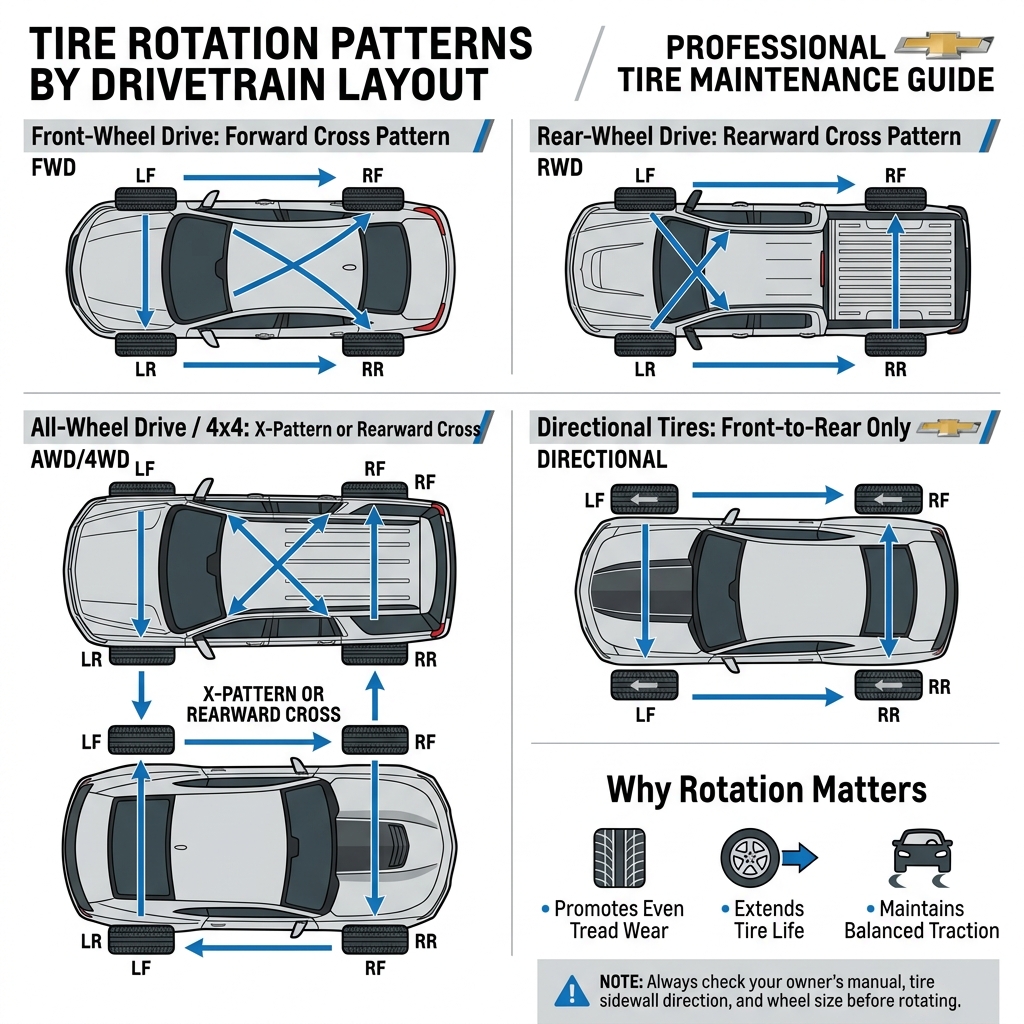
AI generated: Create a clean, professional automotive infographic showing tire rotation diagrams for different drivetrain layouts. Use a vertical service-center layout with clear top-down vehicle illustrations and arrows showing tire movement. Include four labeled sections: “Front-Wheel Drive: Forward Cross Pattern,” “Rear-Wheel Drive: Rearward Cross Pattern,” “All-Wheel Drive / 4x4: X-Pattern or Rearward Cross,” and “Directional Tires: Front-to-Rear Only.” Show each vehicle from above with four tires, simple arrow paths, and labels for LF, RF, LR, and RR. Add a small note: “Always check your owner’s manual, tire sidewall direction, and wheel size before rotating.” Include a secondary callout titled “Why Rotation Matters” with three icons: even tread wear, longer tire life, and balanced traction. Style should be modern dealership service infographic, clean vector design, high contrast, white background, easy-to-read labels, minimal clutter, Chevrolet truck service theme, professional automotive maintenance visual.


The pattern used to move your tires isn’t random—it’s determined by your vehicle’s drivetrain:

  • Forward Cross (FWD): The front tires move straight back to the rear. The rear tires move to the opposite front positions (Left Rear to Right Front).
  • Rearward Cross (RWD/AWD): The rear tires move straight forward. The front tires move to the opposite rear positions. This is common for a Shop New Chevrolet Tahoe with 4WD.
  • X-Pattern: Tires move diagonally (Left Front to Right Rear, etc.). This is often used as an alternative for RWD vehicles.

Using the wrong pattern can actually accelerate wear or lead to handling issues, which is why professional service is always recommended.


Timing is Everything: When to Rotate


The general rule of thumb for most vehicles is to rotate your tires every 5,000 to 7,500 miles. However, a much easier way to remember is to align your tire rotation with every oil change. Since your vehicle is already in the shop and on a lift, it adds very little time to the service but provides massive long-term benefits. If you drive a high-performance vehicle like the Shop New Chevrolet Corvette, or if you frequently use your truck for heavy towing in the hills of Alabama, you might need more frequent rotations. Heat and weight are the enemies of rubber, and both are prevalent during an Alabama summer. Consistency is the key to getting the full 50,000 or 60,000 miles out of your tire warranty.


Warning Signs You Shouldn’t Ignore
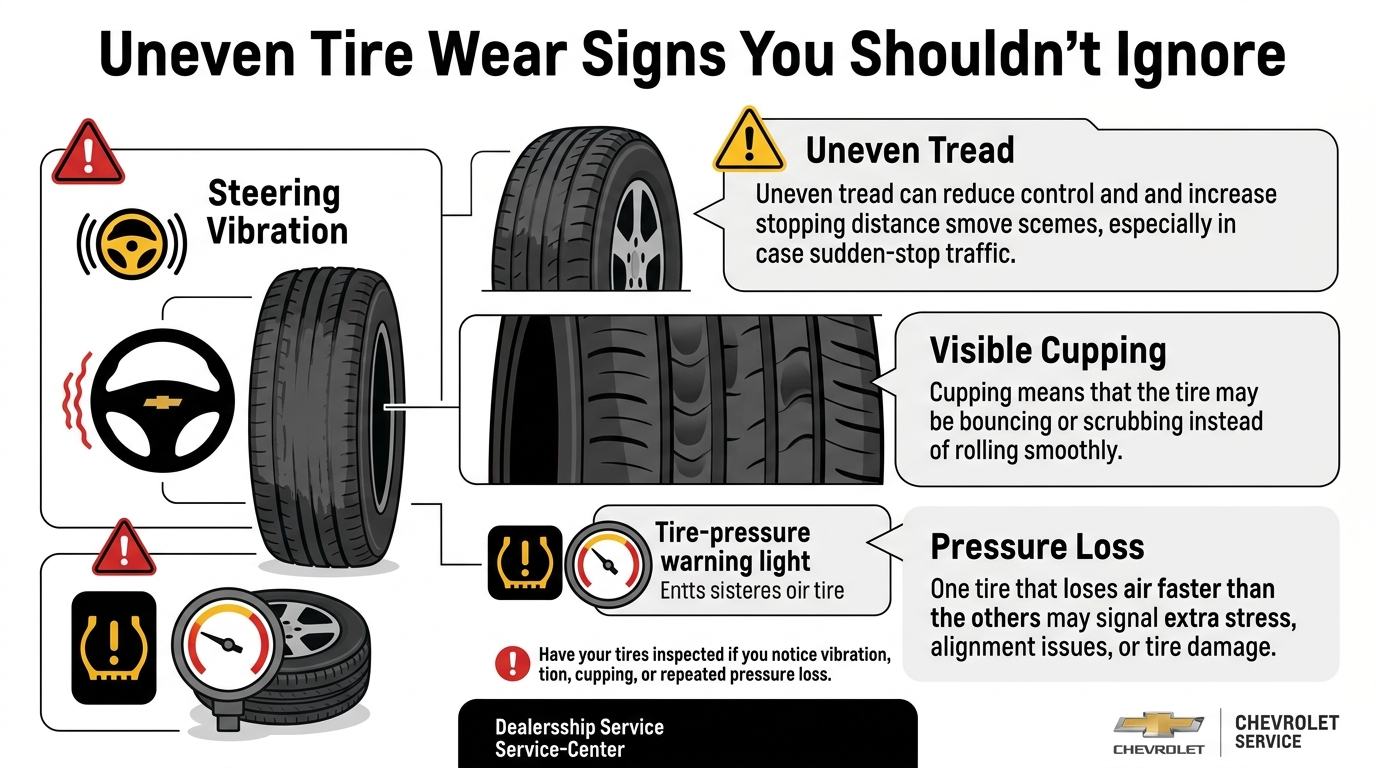
 

Steering Vibration

If you feel a shimmy or vibration in the steering wheel at highway speeds, it often means your front tires have developed uneven wear or are out of balance.

Visible Cupping

Look for ‘cups’ or scalloped dips in the tread. This usually indicates that the tire is bouncing or scrubbing rather than rolling smoothly.

Pressure Loss

If one tire consistently loses pressure faster than the others, it may be experiencing more stress due to its position or an alignment issue.

AI generated: Create a clean, professional automotive infographic titled “Uneven Tire Wear Signs You Shouldn’t Ignore.” Use a vertical dealership service-center layout with realistic tire illustrations, simple warning icons, and clear callout sections. Include three main warning signs: “Steering Vibration” — show a steering wheel vibration icon and a tire with uneven tread, explaining that uneven tread can reduce control and increase stopping distance, especially in sudden-stop traffic; “Visible Cupping” — show a close-up tire tread with scalloped dips or cup-shaped wear marks, explaining that cupping means the tire may be bouncing or scrubbing instead of rolling smoothly; and “Pressure Loss” — show a tire-pressure warning light and a low-pressure gauge, explaining that one tire losing air faster than the others may signal extra stress, alignment issues, or tire damage. Add a small safety callout: “Have your tires inspected if you notice vibration, cupping, or repeated pressure loss.” Style should be modern automotive service infographic, clean vector design, high contrast, white background, red/yellow warning accents, easy-to-read labels, professional Chevrolet dealership service theme, minimal clutter.

Need New Rubber? Explore Our Parts Department


Sometimes, tires are too far gone for a rotation to save them. If your tread depth is below 2/32 of an inch, it’s time for a fresh set. We stock name-brand tires specifically designed for Chevrolet performance.


The Financial Impact: Saving at the Pump and the Shop


Better Fuel Economy: Unevenly worn tires create more rolling resistance. This means your engine has to work harder to push the vehicle down the road, which directly translates to lower MPG. By keeping your tread even, you keep your fuel costs down. For those looking to maximize efficiency, you might also consider an EV—check out our Shop New Chevrolet Silverado EV options.


Avoiding Early Replacement: A full set of tires for a modern SUV like the Shop New Chevrolet Suburban is a significant expense. If you don’t rotate, you might find yourself replacing the front two tires every 15,000 miles. With proper rotation, that same set could last 50,000 miles. Before you buy, you can always Apply For Credit Now to see your financing options.


The Value of Professional Inspection

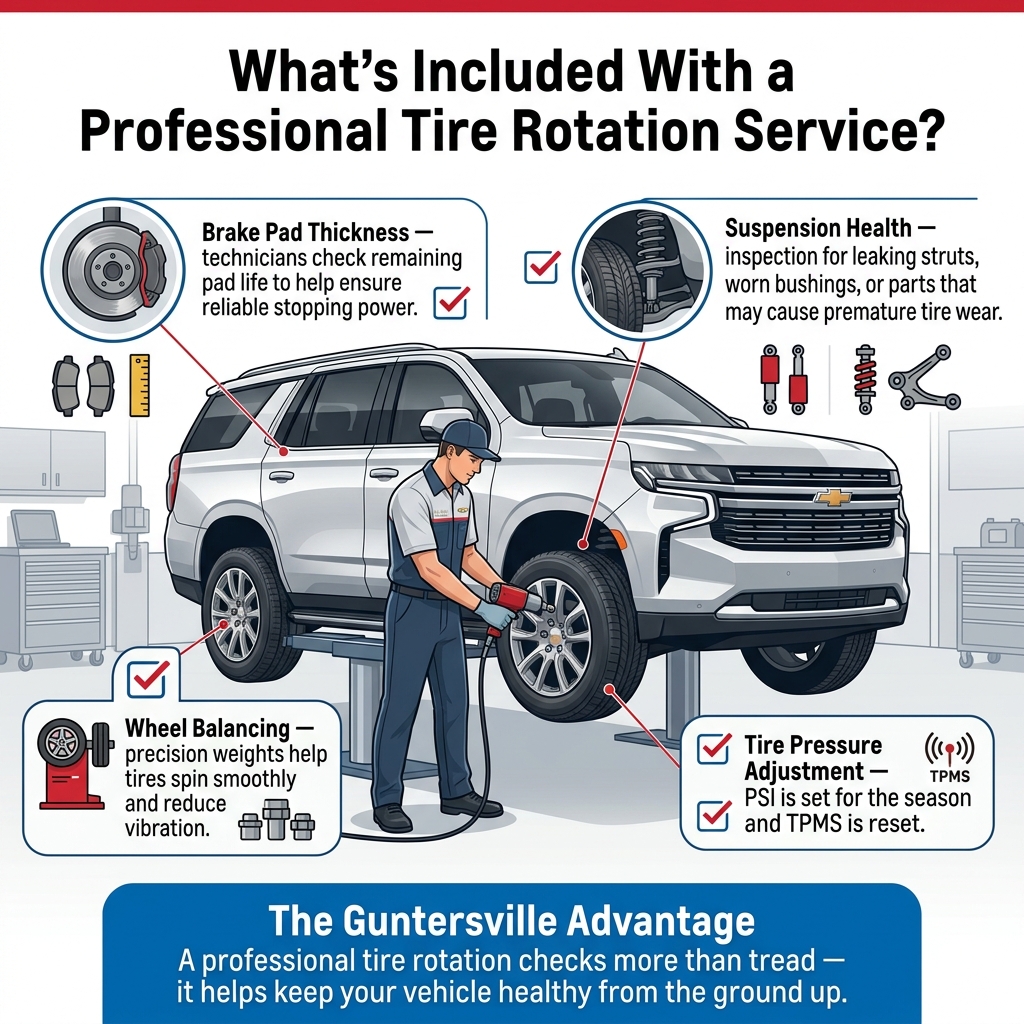
AI generated: Create a clean, professional automotive service infographic titled “What’s Included With a Professional Tire Rotation Service?” Use a vertical dealership service-center layout with a Chevrolet service theme and a checklist format. Show a technician removing a wheel from a vehicle, with four clear inspection callouts around the vehicle. Include these checklist items: “Brake Pad Thickness — technicians check remaining pad life to help ensure reliable stopping power,” “Suspension Health — inspection for leaking struts, worn bushings, or parts that may cause premature tire wear,” “Wheel Balancing — precision weights help tires spin smoothly and reduce vibration,” and “Tire Pressure Adjustment — PSI is set for the season and TPMS is reset.” Add a bottom banner titled “The Guntersville Advantage” with the message: “A professional tire rotation checks more than tread — it helps keep your vehicle healthy from the ground up.” Use clean vector illustrations, realistic tire and brake details, simple icons, checkmarks, red and blue dealership accents, white background, high contrast, easy-to-read text, modern service-center style, minimal clutter.


While you could technically rotate your tires in your driveway, a professional service at Guntersville Chevrolet provides several critical layers of inspection that a DIYer might miss. When our technicians have the wheels off, they perform a multi-point inspection including:

  • Brake Pad Thickness: We check how much ‘life’ is left on your pads, ensuring you have stopping power when you need it.
  • Suspension Health: We look for leaking struts or worn bushings that could be causing your tires to wear prematurely.
  • Wheel Balancing: We use precision weights to ensure each tire spins perfectly, preventing vibrations.
  • Tire Pressure Adjustment: We reset your TPMS and ensure every tire is at the optimal PSI for the current season.

This holistic approach is part of the ‘Guntersville Advantage,’ ensuring your car is healthy from the ground up.


Guntersville Driving Conditions & Your Tires


Driving in Marshall County presents unique challenges for your tires. The intense Alabama summer heat can cause pavement temperatures on Highway 431 to soar, which softens tire rubber and accelerates wear. Furthermore, the hilly terrain around Lake Guntersville puts extra stress on your braking system and tires during descents. If your tires aren’t rotated, these local factors will wear down your tread much faster than the national average. As your local experts, we understand these specific environmental stressors and can recommend the best maintenance schedule to keep your vehicle performing at its peak. Whether you’re commuting to Huntsville or towing a boat to the marina, we ensure your tires are up to the task.


Visit Guntersville Chevrolet Today


We are conveniently located to serve the entire Guntersville community. Whether you need a quick rotation or a full set of new tires, our team is ready to help. Get Directions to Guntersville Chevrolet and stop by, or Call us at (256) 578-9170 to speak with a service advisor directly.


Frequently Asked Tire Questions


Can I rotate a full-size spare?
Yes! If your vehicle has a matching full-size spare, it should be included in the rotation cycle to ensure all five tires wear at the same rate.


What about directional tires?
Directional tires have a specific ‘one-way’ tread pattern. They can only be rotated front-to-back, never side-to-side, to maintain their performance.


Best tires to the rear?
When replacing only two tires, the new ones should always go on the rear to provide better stability and prevent fishtailing on wet roads.


Beyond Rotation: Total Tire Health


Tire rotation is just one leg of the ‘tire maintenance tripod.’ To truly maximize your safety and savings, you also need to focus on wheel alignment and air pressure monitoring. Alignment ensures that your tires are pointing in the exact same direction, preventing them from ‘dragging’ across the pavement. Meanwhile, keeping your tires at the correct PSI prevents internal damage and improves ride quality. To keep your vehicle looking as good as it performs, don’t forget to check out our Accessories Ordering Page for custom wheels and tire care products.


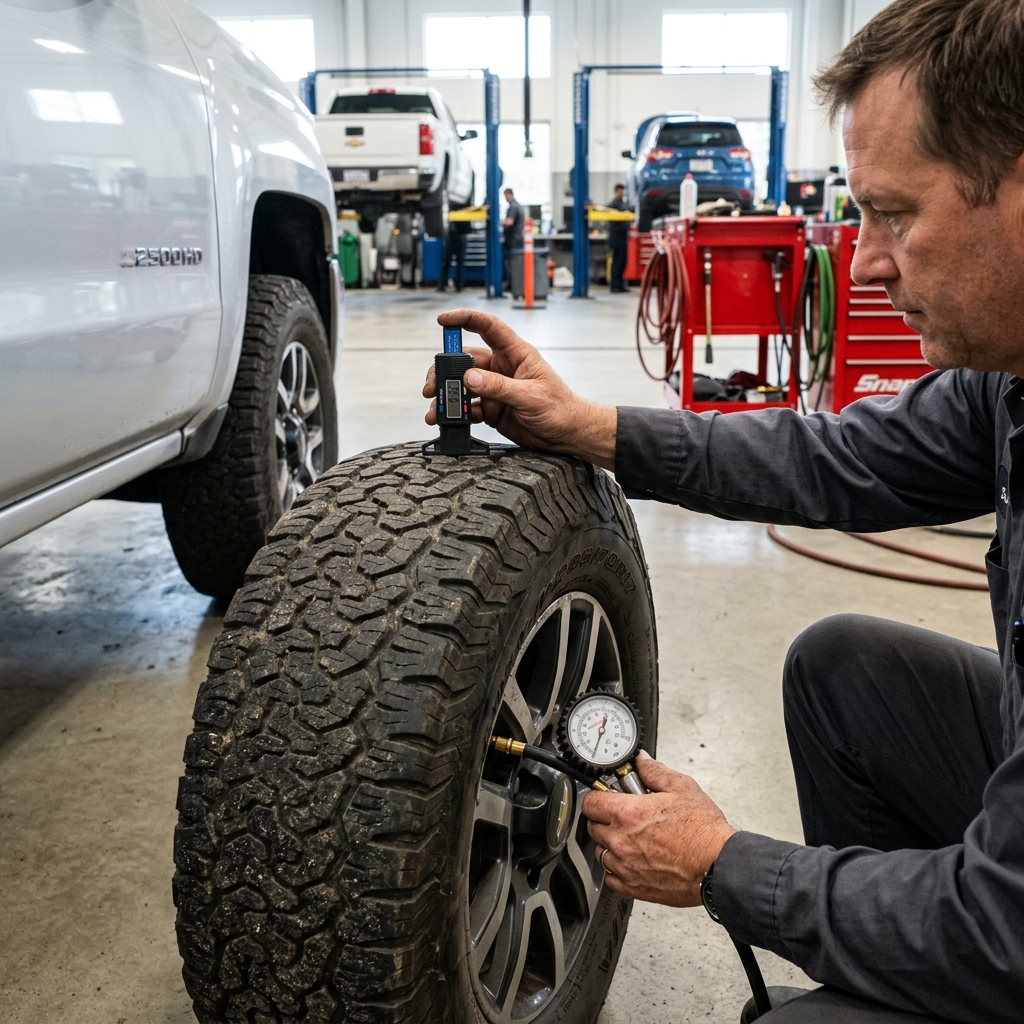
Mechanic measuring tire tread depth and air pressure on an off-road truck tire in a service shop.

Ready for a Smoother Ride?


Whether you are ready to Value Your Trade for a newer model or simply need to maintain your current daily driver, Guntersville Chevrolet is here for you. Explore our Shop New Chevrolet Silverado 2500 inventory if you need more power, or schedule your next maintenance visit today. Your tires are the only thing between you and the road—let’s make sure they’re in top shape.