


Why Is Tire Rotation Critical for All-Wheel Drive (AWD) Systems?
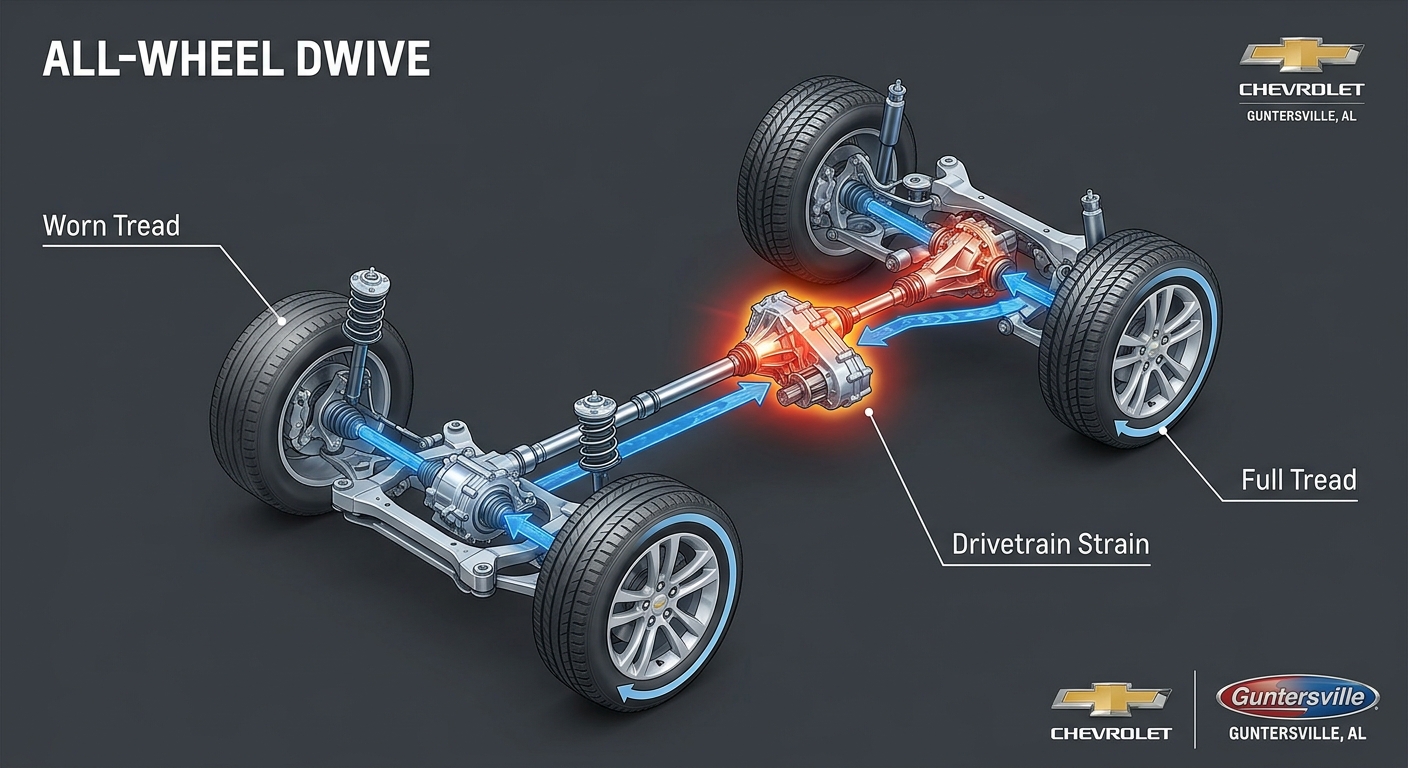
Tire rotation is critical for all-wheel drive (AWD) systems because even minor tread depth variances alter the rolling circumference of individual wheels, forcing center differentials and transfer cases to work continuously to compensate for rotational speed differences. This continuous stress generates excessive friction and heat, accelerating wear on internal drivetrain components and potentially leading to total system failure.
All-wheel drive systems automatically transfer engine torque across the front and rear axles to maintain traction on slippery pavement or uneven terrain. Vehicles like the 2026 Chevrolet Traverse with all-wheel drive or the 2026 Chevrolet Equinox rely on precise electronic and mechanical sensors to monitor wheel speed. When tire treads wear unevenly—such as when front tires wear faster due to steering and braking forces—the outer diameter of the front tires shrinks compared to the rear tires.
A circumference difference as small as 2/32 of an inch causes the shorter tire to rotate faster than the taller tire at the same vehicle speed. The drivetrain control unit interprets this rotational speed discrepancy as active wheel slip. Consequently, the transfer case clutches or viscous couplings engage constantly, generating thermal breakdown in fluid lubricants and placing extreme strain on gear assemblies. Maintaining equal tread depth across all four wheel positions prevents drivetrain binding and preserves key drivetrain components.
If you ever experience unexpected tire damage or drivetrain issues while traveling, relying on manufacturer-backed support ensures proper vehicle care. Chevrolet Roadside Assistance: (800) 243-8872 provides factory-authorized towing, flat tire changes, and emergency assistance directly to certified service centers. Drivers can visit our facility located at 11982 US, Suite C, Guntersville, AL 35976 or call us at (256) 578-9170. You can also use our online service scheduler for routine maintenance or schedule an EV test drive to explore our latest lineup.
Table of Contents
- What Are the Primary Benefits of Regular Tire Rotation for Longevity and Fuel Efficiency?
- Which Tire Rotation Patterns Work Best for FWD, RWD, and 4WD Vehicles?
- How Do You Correctly Rotate Directional, Staggered, and Full-Size Spare Tires?
- How Does Tread Depth Variance Directly Impact Your Drivetrain and Warranty Coverage?
- What Are the Recommended Maintenance Intervals for Local Drivers?
- Common Questions About Tire Rotation Intervals and Drivetrain Protection
- Keep Your Vehicle Running Smoothly with Regular Tire Rotation
What Are the Primary Benefits of Regular Tire Rotation for Longevity and Fuel Efficiency?
Regular tire rotation extends tread life by 20 to 30 percent—adding up to 10,000 miles of usable tire service—while improving fuel economy by 1 to 3 percent through uniform rolling resistance across all four tires. By redistributing the specific mechanical friction associated with each wheel position, routine rotation ensures predictable handling and optimal energy efficiency.
Front tires sustain heavy scrubbing forces from turning, absorbing the majority of vehicle weight during hard stops and carrying the engine weight on front-engine vehicles. Rear tires typically experience straight-line tracking with less lateral force. Without regular rotation, front treads wear down significantly faster along the outer edges and shoulders. Swapping positions balances these distinct wear patterns, allowing the full tread rubber compound to wear down at an equal rate across the tire footprint.
Uniform tread wear directly impacts fuel efficiency by minimizing overall rolling resistance. When tires develop uneven tread wear, cupping, or feathering, the irregular contact patch drags against the road surface, requiring more engine power to maintain momentum. For example, a 2026 Chevrolet Silverado 1500 equipped with the 2.7L TurboMax engine and Hydra-Matic transmission generates 310 hp and 430 lb-ft of torque, delivering fuel ratings like 16 city / 17 hwy on Custom 4X4 configurations. Keeping tires uniformly rotated ensures the engine and transmission operate at peak efficiency without fighting unnecessary friction.
Vehicle maintenance directly preserves trade-in value when upgrading your truck or SUV. Drivers exploring our pre-owned vehicle inventory often look for complete service records showing regular tire care. When replacement components or factory parts are required, accessing our online GM parts ordering portal ensures access to original equipment specifications. To see how other local owners maintain their vehicles, explore our verified customer reviews.
Engine & Performance
Powertrain specs by trim
| Feature | Custom 4X4 Crew Cab Short Box | Custom 4X4 Crew Cab Standard Box | Custom 4X4 Double Cab Std Box | Custom Crew Cab Short Box | Custom Double Cab Std Box | Custom Trail Boss 4X4 Crew Cab Short Box | Custom Trail Boss 4X4 Crew Cab Std Box | High Country 4X4 Crew Cab Short Box | High Country 4X4 Crew Cab Standard Box | High Country Crew Cab Short Box | LT 2FL 4X4 Crew Cab Short Box | LT 2FL 4X4 Double Cab Std Box | LT Trail Boss 4X4 Crew Cab Short Box | LT Trail Boss 4X4 Crew Cab Standard Box | LTZ 4X4 Crew Cab Short Box | LTZ 4X4 Crew Cab Standard Box | LTZ Crew Cab Short Box | RST Crew Cab Short Box | Work Truck 1WT 4X4 Crew Cab Short Box | Work Truck 1WT 4X4 Crew Cab Standard Box | Work Truck 1WT 4X4 Double Cab Std Box | Work Truck 1WT 4X4 Regular Cab Long Box | Work Truck 1WT 4X4 Regular Cab Std Box | Work Truck 1WT Crew Cab Short Box | Work Truck 1WT Crew Cab Standard Box | Work Truck 1WT Double Cab Std Box | Work Truck 1WT Regular Cab Long Box | Work Truck 1WT Regular Cab Standard Box | ZR2 4X4 Crew Cab Short Box |
|---|---|---|---|---|---|---|---|---|---|---|---|---|---|---|---|---|---|---|---|---|---|---|---|---|---|---|---|---|---|
| Engine | 2.7L | 2.7L | 2.7L | 2.7L | 2.7L | 2.7L | 2.7L | 5.3L | 5.3L | 5.3L | 2.7L | 2.7L | 2.7L | 2.7L | 5.3L | 5.3L | 5.3L | 2.7L | 2.7L | 2.7L | 2.7L | 2.7L | 2.7L | 2.7L | 2.7L | 2.7L | 2.7L | 2.7L | 3L |
| Horsepower | 310 hp | 310 hp | 310 hp | 310 hp | 310 hp | 310 hp | 310 hp | 355 hp | 355 hp | 355 hp | 310 hp | 310 hp | 310 hp | 310 hp | 355 hp | 355 hp | 355 hp | 310 hp | 310 hp | 310 hp | 310 hp | 310 hp | 310 hp | 310 hp | 310 hp | 310 hp | 310 hp | 310 hp | 305 hp |
| Torque | 430 lb-ft | 430 lb-ft | 430 lb-ft | 430 lb-ft | 430 lb-ft | 430 lb-ft | 430 lb-ft | 383 lb-ft | 383 lb-ft | 383 lb-ft | 430 lb-ft | 430 lb-ft | 430 lb-ft | 430 lb-ft | 383 lb-ft | 383 lb-ft | 383 lb-ft | 430 lb-ft | 430 lb-ft | 430 lb-ft | 430 lb-ft | 430 lb-ft | 430 lb-ft | 430 lb-ft | 430 lb-ft | 430 lb-ft | 430 lb-ft | 430 lb-ft | 495 lb-ft |
| Transmission | Hydra-Matic | Hydra-Matic | Hydra-Matic | Hydra-Matic | Hydra-Matic | Hydra-Matic | Hydra-Matic | Hydra-Matic | Hydra-Matic | Hydra-Matic | Hydra-Matic | Hydra-Matic | Hydra-Matic | Hydra-Matic | Hydra-Matic | Hydra-Matic | Hydra-Matic | Hydra-Matic | Hydra-Matic | Hydra-Matic | Hydra-Matic | Hydra-Matic | Hydra-Matic | Hydra-Matic | Hydra-Matic | Hydra-Matic | Hydra-Matic | Hydra-Matic | Hydra-Matic |
| Drivetrain | All-wheel drive | All-wheel drive | All-wheel drive | Rear-wheel drive | Rear-wheel drive | All-wheel drive | All-wheel drive | All-wheel drive | All-wheel drive | Rear-wheel drive | All-wheel drive | All-wheel drive | All-wheel drive | All-wheel drive | All-wheel drive | All-wheel drive | Rear-wheel drive | Rear-wheel drive | All-wheel drive | All-wheel drive | All-wheel drive | All-wheel drive | All-wheel drive | Rear-wheel drive | Rear-wheel drive | Rear-wheel drive | Rear-wheel drive | Rear-wheel drive | All-wheel drive |
Fuel Economy
Fuel economy and range by trim
| Feature | Custom 4X4 Crew Cab Short Box | Custom 4X4 Crew Cab Standard Box | Custom 4X4 Double Cab Std Box | Custom Crew Cab Short Box | Custom Double Cab Std Box | Custom Trail Boss 4X4 Crew Cab Short Box | Custom Trail Boss 4X4 Crew Cab Std Box | High Country 4X4 Crew Cab Short Box | High Country 4X4 Crew Cab Standard Box | High Country Crew Cab Short Box | LT 2FL 4X4 Crew Cab Short Box | LT 2FL 4X4 Double Cab Std Box | LT Trail Boss 4X4 Crew Cab Short Box | LT Trail Boss 4X4 Crew Cab Standard Box | LTZ 4X4 Crew Cab Short Box | LTZ 4X4 Crew Cab Standard Box | LTZ Crew Cab Short Box | RST Crew Cab Short Box | Work Truck 1WT 4X4 Crew Cab Short Box | Work Truck 1WT 4X4 Crew Cab Standard Box | Work Truck 1WT 4X4 Double Cab Std Box | Work Truck 1WT 4X4 Regular Cab Long Box | Work Truck 1WT 4X4 Regular Cab Std Box | Work Truck 1WT Crew Cab Short Box | Work Truck 1WT Crew Cab Standard Box | Work Truck 1WT Double Cab Std Box | Work Truck 1WT Regular Cab Long Box | Work Truck 1WT Regular Cab Standard Box | ZR2 4X4 Crew Cab Short Box |
|---|---|---|---|---|---|---|---|---|---|---|---|---|---|---|---|---|---|---|---|---|---|---|---|---|---|---|---|---|---|
| MPG | 16 city / 17 hwy / 16 combined | 16 city / 17 hwy / 16 combined | 16 city / 17 hwy / 16 combined | 18 city / 21 hwy / 19 combined | 18 city / 21 hwy / 19 combined | 16 city / 17 hwy / 16 combined | 16 city / 17 hwy / 16 combined | 16 city / 19 hwy / 17 combined | 16 city / 19 hwy / 17 combined | 16 city / 21 hwy / 18 combined | 17 city / 20 hwy / 18 combined | 17 city / 20 hwy / 18 combined | 16 city / 17 hwy / 16 combined | 16 city / 17 hwy / 16 combined | 16 city / 19 hwy / 17 combined | 16 city / 19 hwy / 17 combined | 16 city / 21 hwy / 18 combined | 18 city / 21 hwy / 19 combined | 17 city / 20 hwy / 18 combined | 17 city / 20 hwy / 18 combined | 17 city / 20 hwy / 18 combined | 17 city / 20 hwy / 18 combined | 17 city / 20 hwy / 18 combined | 18 city / 21 hwy / 19 combined | 18 city / 21 hwy / 19 combined | 18 city / 21 hwy / 19 combined | 18 city / 21 hwy / 19 combined | 18 city / 21 hwy / 19 combined | 20 city / 23 hwy / 21 combined |
Which Tire Rotation Patterns Work Best for FWD, RWD, and 4WD Vehicles?
The correct tire rotation pattern depends on drivetrain layout: front-wheel-drive models use a forward cross pattern, rear-wheel and four-wheel-drive vehicles utilize a rearward cross pattern, and symmetrical all-wheel-drive configurations often rely on an X-pattern. Selecting the proper movement sequence guarantees that every tire rotates through each corner of the vehicle over time.
For front-wheel-drive vehicles, such as the standard 2026 Chevrolet Equinox with front-wheel drive powered by a 1.5L engine and CVT transmission yielding 26 city / 29 hwy, the forward cross pattern is standard. The front tires move straight back to the rear axle on the same side. The rear tires move forward to the front axle while crossing sides—the rear left tire moves to the front right position, and the rear right tire moves to the front left position.
For rear-wheel-drive and traditional truck-based four-wheel-drive systems, the rearward cross pattern is recommended. In this sequence, the front tires move diagonally back to the opposite rear positions, while the rear tires move straight forward to the front axle on the same side. This balances the heavy torque output delivered to the rear drive axle with the steering friction concentrated on the front axle.
All-wheel-drive vehicles, including the 2026 Chevrolet Traverse featuring an 8-speed automatic transmission, often benefit from an X-pattern when using non-directional tires. In an X-pattern, all four tires switch corners diagonally: front left swaps with rear right, and front right swaps with rear left. This ensures maximum dispersion of tread wear across all four wheel positions.
- Forward Cross (FWD): Front tires go straight back; rear tires cross to opposite front positions.
- Rearward Cross (RWD / 4WD): Rear tires go straight forward; front tires cross to opposite rear positions.
- X-Pattern (AWD / Standard): All four tires move diagonally to opposite corners.
Matching rotation patterns to vehicle engineering ensures smooth performance across the Chevrolet lineup. Drivers interested in efficient crossover options can view the 2026 Chevrolet Equinox or explore versatile truck capability with the Chevrolet Silverado 1500 and spacious Chevrolet Traverse. You can also examine full-size options like the 2026 Chevrolet Tahoe, midsize trucks like the 2026 Chevrolet Colorado, browse our full Chevrolet model showroom, or search our comprehensive new vehicle inventory.
How Do You Correctly Rotate Directional, Staggered, and Full-Size Spare Tires?
Specialized tire designs demand strict rotation methods: directional tires must stay on the same side of the vehicle and move strictly front-to-back, staggered tire fitments rotate side-to-side across the same axle, and full-size spare tires integrate into a five-tire rotation pattern. Deviating from these specialized rules can compromise wet-weather traction or cause physical clearance issues.
Directional tires feature tread patterns designed to channel water away from the contact patch when rolling in one specific direction. Sidewall arrows indicate the required direction of rotation. Crossing a directional tire to the opposite side of the vehicle reverses its intended rotation direction, reducing hydroplaning resistance. Directional tires on uniform wheels must swap straight front-to-back on the left side and right side independently.
Staggered tire configurations feature larger tires and wheels on the rear axle than on the front axle, a setup commonly found on high-performance sports cars. Because front and rear wheel sizes differ, tires cannot move between axles. Non-directional staggered tires rotate side-to-side across the front axle and rear axle separately. If staggered tires are also directional, they cannot be rotated without dismounting the rubber from the wheels.
Full-size spare tires should be integrated into a five-tire rotation sequence during regular service intervals. Including the spare ensures all five tires wear down at an equal rate. In a typical rearward cross five-tire pattern, the spare tire moves into the right rear position, the rear right tire moves to the front right, the front right tire crosses to the rear left, the rear left tire moves to the front left, and the front left tire becomes the new spare.
When tire rubber reaches minimum tread limits, visiting our certified tire center ensures exact original equipment replacements. Drivers preparing to upgrade can utilize our online trade-in evaluation tool to assess current vehicle value, and review current Chevrolet special offers for seasonal maintenance programs.
Dimensions & Capacity
Capacity and dimensions by trim
| Feature | Custom 4X4 Crew Cab Short Box | Custom 4X4 Crew Cab Standard Box | Custom 4X4 Double Cab Std Box | Custom Crew Cab Short Box | Custom Double Cab Std Box | Custom Trail Boss 4X4 Crew Cab Short Box | Custom Trail Boss 4X4 Crew Cab Std Box | High Country 4X4 Crew Cab Short Box | High Country 4X4 Crew Cab Standard Box | High Country Crew Cab Short Box | LT 2FL 4X4 Crew Cab Short Box | LT 2FL 4X4 Double Cab Std Box | LT Trail Boss 4X4 Crew Cab Short Box | LT Trail Boss 4X4 Crew Cab Standard Box | LTZ 4X4 Crew Cab Short Box | LTZ 4X4 Crew Cab Standard Box | LTZ Crew Cab Short Box | RST Crew Cab Short Box | Work Truck 1WT 4X4 Crew Cab Short Box | Work Truck 1WT 4X4 Crew Cab Standard Box | Work Truck 1WT 4X4 Double Cab Std Box | Work Truck 1WT 4X4 Regular Cab Long Box | Work Truck 1WT 4X4 Regular Cab Std Box | Work Truck 1WT Crew Cab Short Box | Work Truck 1WT Crew Cab Standard Box | Work Truck 1WT Double Cab Std Box | Work Truck 1WT Regular Cab Long Box | Work Truck 1WT Regular Cab Standard Box | ZR2 4X4 Crew Cab Short Box |
|---|---|---|---|---|---|---|---|---|---|---|---|---|---|---|---|---|---|---|---|---|---|---|---|---|---|---|---|---|---|
| Seating | 6 | 6 | 6 | 6 | 6 | 6 | 6 | 5 | 5 | 5 | 6 | 6 | 6 | 6 | 5 | 5 | 5 | 6 | 6 | 6 | 6 | 3 | 3 | 6 | 6 | 6 | 3 | 3 | 5 |
| Curb weight | 4,950 lbs | 5,010 lbs | 4,150 lbs | 4,700 lbs | 4,150 lbs | 5,010 lbs | 5,070 lbs | 5,080 lbs | 5,130 lbs | 4,860 lbs | 4,950 lbs | 4,940 lbs | 5,010 lbs | 5,070 lbs | 5,080 lbs | 5,130 lbs | 4,860 lbs | 4,700 lbs | 4,950 lbs | 5,010 lbs | 4,940 lbs | 4,750 lbs | 4,630 lbs | 4,700 lbs | 4,810 lbs | 4,660 lbs | 4,510 lbs | 4,410 lbs | 5,550 lbs |
| Towing | 9,000 lbs | 9,000 lbs | 9,000 lbs | 9,200 lbs | 9,200 lbs | 9,000 lbs | 9,000 lbs | 9,300 lbs | 9,300 lbs | 9,500 lbs | 9,000 lbs | 9,000 lbs | 9,000 lbs | 9,000 lbs | 9,300 lbs | 9,300 lbs | 9,500 lbs | 9,200 lbs | 9,000 lbs | 9,000 lbs | 9,000 lbs | 9,300 lbs | 8,900 lbs | 9,200 lbs | 9,200 lbs | 9,200 lbs | 9,500 lbs | 9,100 lbs | 9,000 lbs |
| Payload | 2,050 lbs | 1,990 lbs | 2,850 lbs | 2,100 lbs | 2,650 lbs | 1,990 lbs | 1,930 lbs | 1,920 lbs | 1,870 lbs | 1,940 lbs | 2,050 lbs | 2,060 lbs | 1,990 lbs | 1,930 lbs | 1,920 lbs | 1,870 lbs | 1,940 lbs | 2,100 lbs | 2,050 lbs | 1,990 lbs | 2,060 lbs | 2,150 lbs | 2,170 lbs | 2,100 lbs | 1,990 lbs | 2,140 lbs | 2,290 lbs | 2,290 lbs | 1,550 lbs |
How Does Tread Depth Variance Directly Impact Your Drivetrain and Warranty Coverage?
Tread depth discrepancies beyond 2/32 of an inch place continuous mechanical stress on transfer cases, center differentials, and axle assemblies, while failing to document routine rotations can void tire manufacturer wear-out warranties. Maintaining matching tread depth preserves both mechanical longevity and financial protection.
When one tire wears significantly faster than the others on an AWD vehicle, the difference in rolling radius forces internal differential gears to spin constantly, even when driving straight on dry highway pavement. Internal clutches generate severe friction, breaking down gear oil viscosity and overheating sensitive seals. Over extended distances, this thermal stress leads to gear galling, bearing wear, and premature transfer case failure.
Tire manufacturers establish treadwear warranties based on the expectation that tires receive uniform maintenance throughout their service life. Companies like Michelin require documented proof of tire rotations every 5,000 to 7,500 miles to honor mileage claims. If tires show pronounced edge wear or cupping caused by neglected service, warranty claims for premature wear are routinely denied.
Documenting routine maintenance safeguards vehicle warranty protection and overall value. Buyers can review verified customer testimonials to learn about our service quality. For maintenance planning and vehicle upgrades, explore flexible financing options or complete an online credit application ahead of your visit.
What Are the Recommended Maintenance Intervals for Local Drivers?
Vehicles operating in the area should receive tire rotations every 5,000 to 7,500 miles for standard drivetrains, or every 3,000 to 5,000 miles for all-wheel-drive systems, pairing service visits with routine engine oil changes. Southern heat and varied terrain elevate tire temperatures and accelerate tread shoulder wear.
Navigating the Sand Mountain plateau near Albertville exposes tires to rolling uplands, gravel road transitions, and daily highway commuting. Heat buildup combined with stop-and-go driving breaks down tire compounds faster than steady flatland cruising. Performing rotations near the shorter end of recommended mileage windows mitigates localized rubber degradation before permanent wear patterns form.
When truck owners ask our service team about tire care, we usually show them how front tire shoulder wear on plateau commutes differs from rear tread wear before mapping out a consistent rotation schedule. Combining tire rotation with oil changes ensures technicians can check inflation pressures, inspect brake pad thickness, and verify suspension alignment during a single visit.
- Standard Drivetrains (FWD / RWD): Rotate every 5,000 to 7,500 miles.
- All-Wheel Drive (AWD) Systems: Rotate every 3,000 to 5,000 miles.
- Heavy Towing / Mountain Driving: Inspect tread every 3,000 miles.
Reviewing complete auto parts warranty details provides peace of mind when replacing original equipment components. Our certified service team delivers factory-trained care, while our involvement with the Chevy Cares program reflects our dedication to supporting the local community.
Common Questions About Tire Rotation Intervals and Drivetrain Protection
Q: How does a tire rotation interval differ for all-wheel drive versus front-wheel drive?
All-wheel-drive vehicles require shorter rotation intervals—typically every 3,000 to 5,000 miles—because all four tires actively receive engine torque and must maintain closely matched rolling diameters to prevent transfer case strain. Front-wheel-drive vehicles can follow standard 5,000 to 7,500-mile schedules because the front axle handles primary propulsion and steering duties, allowing the rear tires to serve primarily as trailing wheels until rotated forward.
Q: Will skipping tire rotation void my vehicle or tire warranty?
Skipping tire rotation can void tire treadwear warranties offered by manufacturers, as regular rotation records are required to process mileage wear claims. Vehicle manufacturers also specify routine rotation in owner’s manual maintenance schedules, and failing to maintain equal tread depths on AWD models can lead to denied warranty claims on damaged differential or transfer case components resulting from tread variance.
Q: Can regular tire rotations improve my vehicle’s braking distance and handling?
Regular tire rotations preserve optimal braking distance and cornering grip by maintaining a flat, even tread contact patch on all four corners of the vehicle. When tires wear unevenly, cupping or diagonal tread wear reduces rubber contact with the road surface, increasing stopping distances on wet pavement and compromising anti-lock braking system effectiveness during hard stops.
Q: What are the signs that my tires need an immediate rotation or balancing?
Key signs that tires require immediate inspection include steering wheel vibration at highway speeds, noticeable vehicle pulling to one side, or visible tread height differences between inner and outer tread ribs. Feeling slight cupping or feathering along tire tread blocks when running your hand over the tread face also signals that an immediate rotation and wheel alignment check are needed.
Q: How do technicians verify proper tire pressure and lug nut torque during a rotation?
Factory-trained technicians measure tire pressures using calibrated digital gauges and adjust air pressure to match manufacturer door-jamb specifications, accounting for cold inflation targets. During reinstallation, technicians use a calibrated torque wrench to tighten lug nuts in a star pattern to the exact foot-pound specification, preventing warped brake rotors and ensuring wheel hub seat security.
Community support extends across many areas of focus, including community awareness initiatives. To learn more about our facility values and heritage, visit about our dealership.
Keep Your Vehicle Running Smoothly with Regular Tire Rotation
Adhering to strict tire rotation intervals protects your drivetrain investment, maximizes tread life, and maintains peak fuel economy across all driving conditions. Whether navigating daily commutes or hauling heavy loads, consistent wheel service ensures safe, reliable vehicle performance miles down the road.
Our factory-trained technicians provide comprehensive tire maintenance, digital alignment checks, and original equipment replacement services. Visit our Guntersville facility for professional service or call our team at (256) 578-9170 to schedule your appointment. You can also explore custom vehicle enhancements and exterior upgrades by visiting our official accessories store today.
0 comment(s) so far on Why Is Tire Rotation Critical for All-Wheel Drive (AWD) Systems?