


What Our Service Experts Want You to Know About Tire Health
Understanding the Core Differences Between Tire Rotation and Wheel Alignment
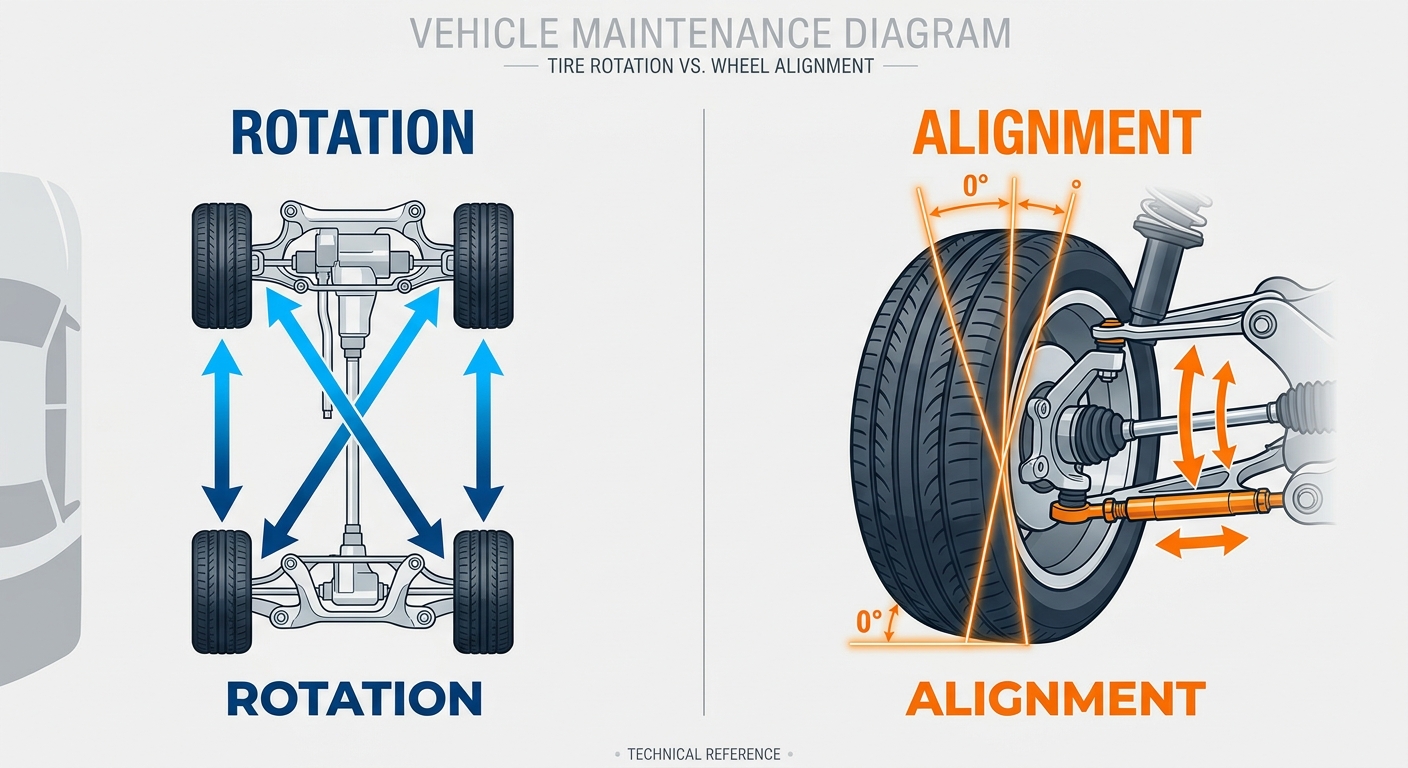
Tire rotation involves physically swapping the positions of the wheels on your vehicle to distribute wear more evenly over time. Because front tires experience different forces than rear tires, particularly during steering and heavy braking, they naturally wear at different rates. By moving them from front to back or side to side, we ensure that no single tire bears a disproportionate amount of friction. This simple maintenance task helps maximize the lifespan of your tread and maintains consistent traction across all four corners of your vehicle.
Wheel alignment, on the other hand, does not involve moving the tires at all but rather adjusting the suspension system that connects your wheels to the vehicle. A technician uses specialized equipment to calibrate the angles at which your tires contact the road, known as camber, caster, and toe. When these angles drift out of factory specification due to potholes or curb impacts, your vehicle may pull to one side or cause the steering wheel to sit off-center. To keep your vehicle performing safely, you can use our online service scheduler to book an inspection. If you need help finding us, you can get directions to our physical service center to speak with our certified technicians in person.
Table of Contents
- How Drivetrains and Daily Commutes Shape Your Chevrolet Tire Rotation Schedule
- Deciphering Tire Rotation Patterns for Trucks, SUVs, and Passenger Cars
- The Real Risks of Skipping Tire Rotations and How to Spot Overdue Wear
- Why Professional Tire Service Outperforms DIY Maintenance
- Keeping Your Chevrolet Safe and Performing at Its Best
How Drivetrains and Daily Commutes Shape Your Chevrolet Tire Rotation Schedule
The way power is delivered to your wheels dictates how your tires wear down over time. In a front-wheel-drive vehicle, the front tires handle steering, braking, and the majority of the engine’s power, causing them to wear out significantly faster than the rear set. Rear-wheel-drive vehicles experience the opposite effect, where the rear tires bear the brunt of acceleration forces. For drivers commuting daily across the Sand Mountain plateau near Albertville, the rolling hills and stop-and-go suburban traffic can accelerate front tire wear on front-wheel-drive models.
All-wheel-drive and four-wheel-drive systems present a different challenge because all four wheels actively receive power from the engine. This active engagement can cause rapid and less predictable tread wear patterns. To prevent premature tire replacement, all-wheel-drive vehicles require more frequent rotations, typically every 3,000 to 5,000 miles, compared to the standard 7,500-mile interval recommended for front- or rear-wheel-drive models. Adhering to these intervals ensures that the tread depth remains uniform, which prevents strain on the vehicle’s center differential.
Whether you are driving a traditional truck or exploring alternative powertrains, keeping up with maintenance is essential. For instance, the new Chevrolet Colorado utilizes a robust four-wheel-drive system that benefits greatly from regular rotation schedules to preserve off-road traction. If you are interested in transitioning to electric power, you can schedule an electric vehicle test drive to experience how instant torque affects tire wear. Don’t forget to check our promotional service and parts offers before booking your next visit to ensure you get the best value.
Deciphering Tire Rotation Patterns for Trucks, SUVs, and Passenger Cars
Using the correct rotation pattern is critical to extending the life of your tire tread. For front-wheel-drive passenger vehicles, the standard pattern is the forward cross. In this configuration, the front tires move directly to the rear, while the rear tires cross to the opposite front positions. This ensures that the steering wear experienced by the front tires is balanced out when they transition to the rear axle.
For rear-wheel-drive and four-wheel-drive trucks, technicians utilize the rearward cross pattern. Here, the rear tires move straight to the front, and the front tires cross to the opposite rear positions. This pattern is particularly important for heavy-duty work trucks like the new Chevrolet Silverado HD, where the rear axle often carries significant payloads that put unique stress on the rear tires. Properly crossing the front tires to the rear helps smooth out any diagonal wear patterns that developed during steering.
Specialized tire designs require alternative approaches. Directional tires, which feature tread patterns designed to roll in only one direction, cannot be crossed; they must stay on the same side of the vehicle and only swap front to back. You can explore the complete Chevrolet model showroom to see how different body styles, such as the sporty new Chevrolet Blazer, utilize specific tire and wheel setups that dictate these precise service patterns.
The Real Risks of Skipping Tire Rotations and How to Spot Overdue Wear
Neglecting regular tire service can lead to severe safety hazards and costly premature replacements. When tires are not rotated, the tread wears down unevenly, which drastically reduces your vehicle’s traction on wet or slippery roads. This uneven wear also creates high and low spots on the tread, leading to noticeable vibrations in the steering wheel and cabin, as well as increased road noise. Over time, these vibrations can put unnecessary stress on your wheel bearings and suspension components.
Technicians measure tread depth in thirty-seconds of an inch to determine tire health. If there is a difference of more than 2/32 inch between your tires, a rotation is overdue and your vehicle may require a suspension check. In large family vehicles like the new Chevrolet Suburban, maintaining even tread wear is vital for preserving the vehicle’s braking efficiency and stability when fully loaded.
Electric vehicles also require strict adherence to rotation schedules due to their unique torque characteristics. The instant torque delivered by models like the new Chevrolet Blazer EV or a pre-owned new Chevrolet Bolt EUV can accelerate tread wear on the drive wheels. Regularly checking your tread depth ensures you maintain maximum efficiency and range, preventing the need for early tire replacements.
Why Professional Tire Service Outperforms DIY Maintenance
While some drivers consider rotating tires at home, professional service offers critical advantages that cannot be replicated in a driveway. Certified technicians do not just swap the wheels; they perform a comprehensive multi-point inspection of the entire braking and suspension system. This allows them to identify worn brake pads, leaking shocks, or damaged steering linkages before they become major safety issues.
Professional shops also utilize specialized balancing machines to ensure that weight is distributed evenly around the tire and wheel assembly. Even a tiny imbalance can cause vibrations at highway speeds, accelerating tire wear and putting extra stress on your wheel bearings. This level of precision is especially important for heavy-duty commercial vehicles, such as those found in our new Brightdrop 400 inventory, where downtime directly impacts business operations.
Furthermore, proper installation requires precise torque specifications for the lug nuts. Under-tightening can cause the wheel to work loose, while over-tightening can warp the brake rotors or stretch the wheel studs. Whether our team is servicing a full-size new Chevrolet Tahoe starting at $61,400 with its robust 5.3L engine and 10-speed automatic transmission, or a compact new Chevrolet Equinox starting at $33,600 with its efficient 1.5L engine and CVT transmission, we use calibrated torque wrenches to guarantee factory-spec safety.
Keeping Your Chevrolet Safe and Performing at Its Best
Staying on top of routine maintenance is the single best way to protect your tire investment and ensure your vehicle remains safe on the road. Regularly checking your tire pressure, keeping an eye out for uneven wear, and adhering to the recommended rotation intervals will keep your vehicle running smoothly. If you ever experience an unexpected tire failure or flat while on the road, remember that manufacturer-backed support is available through Chevrolet Roadside Assistance, which provides brand-specific towing to authorized service centers utilizing genuine parts.
For those looking to upgrade their ride to a highly efficient vehicle, the upcoming new Chevrolet Bolt offers an exciting option that benefits from our specialized EV tire care. To speak with a service advisor about your maintenance schedule or to ask any questions about your vehicle’s handling, feel free to give our service team a call at (256) 578-9170. We are committed to helping you maintain optimal traction, safety, and performance for every mile ahead.
0 comment(s) so far on What Our Service Experts Want You to Know About Tire Health