


What Is a Tire Rotation and Why Is It Important for Your Vehicle?
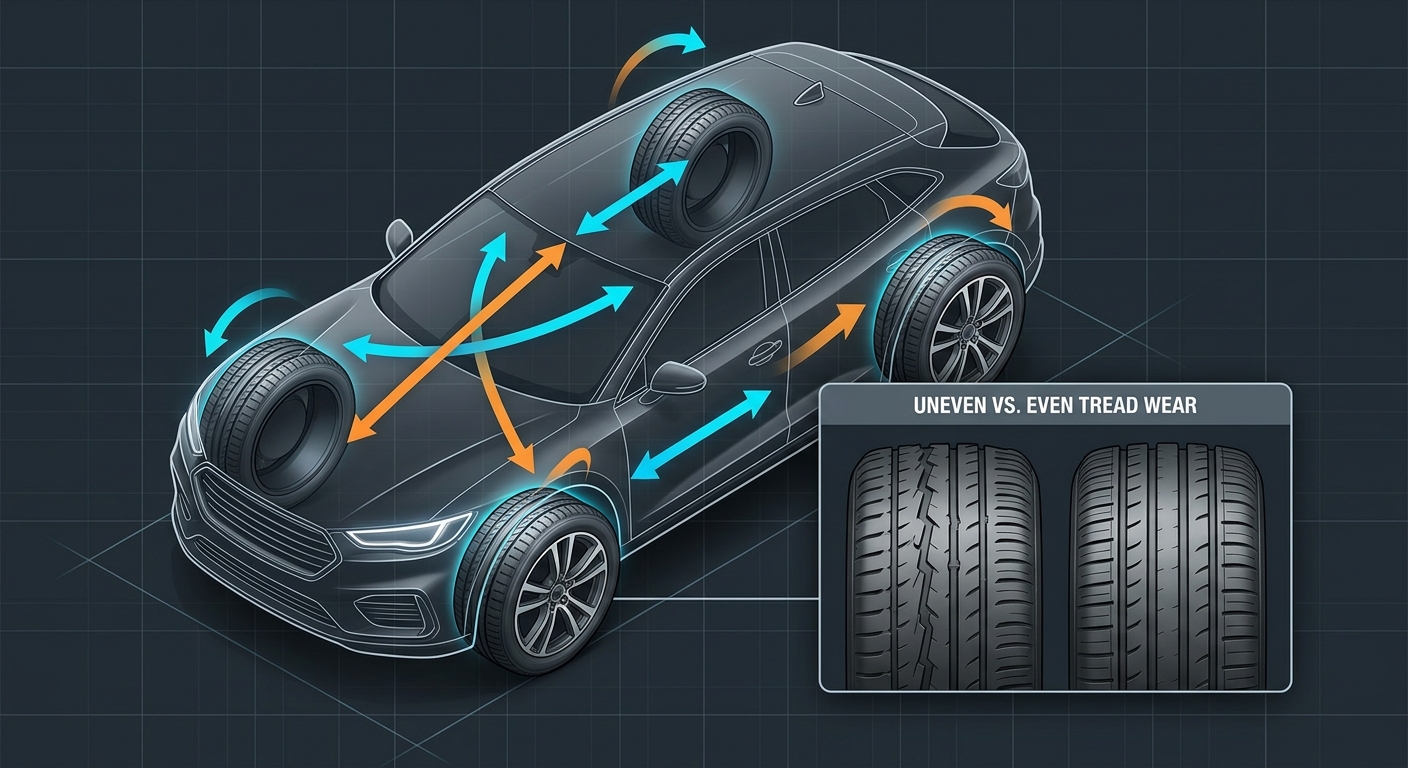
A tire rotation is the routine maintenance process of moving a vehicle’s tires from one wheel position to another—such as swapping front to back or diagonally—in a systematic pattern. It is important because front and rear tires experience different friction and weight loads during acceleration, steering, and braking. Rotating them regularly distributes tread wear evenly across all four tires, preserving vehicle handling, optimizing stopping performance, extending tread life, and protecting factory warranty coverage.
Every vehicle places unequal mechanical demands on its front and rear axles. On most passenger cars, crossovers, and trucks, the front axle supports the heavy weight of the engine and transmission. The front tires also handle all steering forces and absorb the vast majority of braking inertia as weight shifts forward during deceleration. In front-wheel-drive configurations, those same front tires must simultaneously transfer engine torque to the pavement. As a result, front tires routinely wear down up to twice as fast as rear tires if left in the same position over extended mileage.
Uneven tread wear compromises safety long before a tire reaches the end of its physical life. When front tires wear down faster than rear tires, hydroplaning resistance decreases significantly on wet road surfaces. Vehicle stability during hard cornering or emergency lane-change maneuvers also relies on balanced tread depth across all four corners. Moreover, irregular tread wear patterns can lead to uncomfortable cabin vibration and increased rolling resistance, which forces the engine to burn more fuel to maintain cruising speed.
For drivers who regularly haul equipment or tow heavy loads around Lake Guntersville, tire rotation becomes even more critical. Heavy tongue weights compress the rear suspension, altering the contact patch of the rear tires, while heavy payload in the bed places severe stress on the rear axle. Swapping tires according to a consistent schedule prevents localized shoulder wear and heat buildup. Whether you are driving a versatile crossover like the 2026 Chevrolet Equinox with its 1.5L engine and CVT or a heavy-duty pickup, keeping tread wear uniform maintains steady trailering stability. If you ever need assistance finding our service center or showroom, you can check our showroom address in Guntersville or give our service advisors a quick call. You can also explore our current new-vehicle inventory to see the latest models equipped with modern tire pressure monitoring systems and advanced safety tech.
Table of Contents
- How Often Should You Rotate Your Tires and Does Drivetrain Matter?
- What Are the Most Common Tire Rotation Patterns for Front, Rear, and All-Wheel Drive?
- What Happens If You Skip or Ignore Routine Tire Rotations?
- Professional Service vs. DIY: Should You Rotate Tires at Home?
- Frequently Asked Questions About Tire Rotations
- Keep Your Tires Performing Their Best at Chevrolet
How Often Should You Rotate Your Tires and Does Drivetrain Matter?
Tires should generally be rotated every 7,500 miles or 12 months, whichever comes first, though vehicles equipped with all-wheel-drive or those used for heavy towing often require shorter 6,000-mile intervals. Aligning your rotation schedule with your vehicle’s engine oil and filter changes makes it convenient to maintain proper tire care without extra service visits.
Your vehicle’s drivetrain directly dictates how wear forces are distributed across the rubber. Front-wheel-drive vehicles apply engine power exclusively through the front axle, subjecting the front tires to a combination of power delivery, directional control, and primary braking effort. Rear-wheel-drive vehicles split these responsibilities, putting acceleration friction on the rear tires while steering and stopping forces remain on the front. This separation typically results in heavy center-tread wear on the rear tires and heavy outer-shoulder wear on the front pair.
All-wheel-drive and four-wheel-drive vehicles introduce unique mechanical requirements. On these systems, small differences in tire circumference caused by mismatched tread wear can force the transfer case and differentials to continuously slip or strain. If one tire wears down just a few thirty-seconds of an inch more than the others, the vehicle’s onboard computer may sense a false difference in wheel speed, potentially triggering traction control errors or causing mechanical stress across the driveline. For this reason, tire manufacturers and service standards advise rotating tires on all-wheel-drive models at strict 6,000-mile marks to keep all four tread depths within tight tolerances.
Driving habits and local terrain also influence wear velocity. Daily commutes along the gentle elevation changes of the Sand Mountain plateau near Albertville put constant lateral friction on tire shoulders during winding climbs and descent braking. Time is another factor for low-mileage drivers. Even if a vehicle covers fewer than 5,000 miles in a year, tires should still be rotated at least once every six months to prevent flat-spotting and static weight deformation. When evaluating pre-owned vehicles, inspecting tread wear uniformity is a reliable indicator of how well the prior owner maintained the drivetrain. You can browse our pre-owned vehicle inventory to find well-maintained trucks and SUVs that have undergone thorough mechanical inspections.
What Are the Most Common Tire Rotation Patterns for Front, Rear, and All-Wheel Drive?
Tire rotation follows precise technical diagrams based on whether the tires are non-directional or directional, whether all four wheels are the same size, and whether the drivetrain favors the front, rear, or all four wheels. Technicians select the exact pattern that counters the specific mechanical wear tendencies of each vehicle configuration.
- Forward Cross Pattern: Primarily used on front-wheel-drive vehicles equipped with non-directional tires. The front tires move straight back to the rear positions on the same side. The rear tires move up to the front axle but cross sides—the rear-left tire moves to the front-right position, and the rear-right tire moves to the front-left position.
- Rearward Cross Pattern: Recommended for rear-wheel-drive, four-wheel-drive, and all-wheel-drive vehicles with non-directional tires. The rear tires move straight forward to the front positions on the same side. The front tires move to the rear axle and cross sides—the front-left tire goes to the rear-right position, and the front-right tire goes to the rear-left position.
- X-Pattern: Suitable for all drivetrains with non-directional tires, particularly light trucks and sedans showing early signs of diagonal wear. All four tires cross positions—front-left swaps with rear-right, and front-right swaps with rear-left.
- Directional Tire Pattern: Directional tires feature a specific tread pattern designed to roll in only one direction to channel water away efficiently. These tires must remain on the same side of the vehicle. The front-left tire swaps directly with the rear-left tire, and the front-right tire swaps directly with the rear-right tire.
- Staggered Fitment Pattern: Vehicles with larger wheels on the rear axle than the front cannot move tires between front and rear axles. If the tires are non-directional, they are rotated side-to-side across the same axle.
- Full-Size Spare Five-Tire Pattern: When a vehicle carries a matching full-size spare tire and wheel, incorporating it into a five-tire rotation ensures all five tires wear down at the exact same rate. In a rearward cross five-tire pattern, the spare moves to the right-rear position, while the tire that would normally move to that spot becomes the new spare.
Matching the correct pattern to your vehicle protects handling balance and satisfies manufacturer service specifications. Drivers seeking additional peace of mind can inspect our verified certified pre-owned inventory, where every vehicle undergoes a comprehensive multi-point inspection that verifies tread depth and tire wear alignment across all four wheels.
What Happens If You Skip or Ignore Routine Tire Rotations?
Neglecting routine tire rotations causes uneven tread wear, which progressively degrades ride comfort, increases vehicle operating costs, and creates mechanical strain on drivetrain components. Over time, localized wear patterns develop that permanently damage the tire casing long before the main tread compound wears out.
| Wear Pattern | Visual Characteristics | Primary Cause | Driving Symptoms |
|---|---|---|---|
| Heel-Toe Wear | Sawtooth shape along tread blocks | Skipped rotations, heavy braking | Hum or growling noise at highway speed |
| Cupping / Scalloping | Wavy dips or hollows across tread | Unbalanced tires, worn shock absorbers | Rhythmic cabin vibration and wheel hop |
| Feathering | Smooth on one side, sharp edge on other | Incorrect toe alignment, unrotated tires | Steering pull and erratic tracking |
| Center Wear | Bulging center tread worn thin | Over-inflation, high-speed heat | Reduced traction, harsh ride quality |
| Shoulder Wear | Inner or outer edges worn smooth | Under-inflation, aggressive hard cornering | Squealing on turns, reduced wet grip |
One of the most immediate consequences of skipping rotations is the development of cupping or heel-toe wear. Heel-toe wear occurs when one edge of an individual tread block wears down faster than the trailing edge, creating a sawtooth profile. This creates an irritating growling sound at highway speeds that mirrors the noise of a failing wheel bearing. Cupping leaves scooped depressions around the circumference of the tread, leading to persistent steering wheel vibration and reduced tire grip on slick pavement.
Ignoring tire rotation also creates severe financial drawbacks. Unevenly worn tires must be replaced in pairs or full sets much earlier than necessary, forfeiting thousands of miles of usable tread life. Additionally, major tire manufacturers explicitly state in their warranty terms that keeping to the recommended tire rotation schedule is required to maintain treadwear coverage. If tread depth measurements reveal significant variation between tires, warranty claims for premature wear are routinely denied.
When tread degradation becomes severe enough to affect vehicle safety or driveability, replacing tires or upgrading your ride may become necessary. You can quickly value your trade-in online to see what your current truck or crossover is worth toward a well-maintained vehicle.
Professional Service vs. DIY: Should You Rotate Tires at Home?
Rotating tires at home is technically possible with proper garage equipment, but professional dealership service offers crucial diagnostic safety checks, precise tool calibration, and digital reset procedures that home driveways rarely accommodate.
| Service Aspect | DIY Home Rotation | Professional Dealership Service |
|---|---|---|
| Required Equipment | Hydraulic floor jack, 2–4 jack stands, torque wrench, wheel chocks | Heavy-duty hydraulic vehicle lift, calibrated pneumatic/electric torque tools |
| Wheel Balancing | Not available without specialized shop machinery | Dynamic spin balancing available to eliminate high-speed vibration |
| Safety Diagnostics | Visual tread check only | Complete brake pad, rotor, suspension, and steering link inspection |
| TPMS System Care | Manual relearn process via instrument cluster (if supported) | OBD-II digital relearn tool to reassign sensor locations precisely |
| Labor & Effort | Physical lifting, multiple jacking points, manual lug nut torquing | Efficient multi-point service performed by factory-trained technicians |
A DIY rotation requires lifting the vehicle off the ground safely on flat concrete using rated jack stands. Using a vehicle’s emergency jack for a full tire rotation is unsafe, as those jacks are designed strictly for single-wheel roadside changes. Furthermore, wheel lug nuts must be torqued in a star pattern to the exact foot-pound specification listed in the owner’s manual. Overtightening lug nuts with an uncalibrated lug wrench can warp brake rotors, while undertightening risks wheel separation during highway travel.
Professional service provides advantages beyond simply swapping wheel positions. While the wheels are removed, factory-trained technicians perform a detailed inspection of the brake pads, rotors, caliper slide pins, shock absorbers, and steering linkages. They can detect subtle cupping or camber wear that signals the need for a wheel alignment before the tires suffer permanent damage. Additionally, modern vehicles require a Tire Pressure Monitoring System (TPMS) relearn procedure after rotation so the driver display correctly identifies which wheel is low on air.
Our service department makes routine upkeep simple and efficient. You can easily schedule an appointment using our online service scheduling tool. If your vehicle requires broader mechanical repairs or new tires, you can also complete our secure online credit application to explore flexible financing solutions tailored to your service needs.
Frequently Asked Questions About Tire Rotations
Q: What is the recommended interval for tire rotation on a Chevrolet truck?
For Chevrolet pickups like the Silverado 1500, the factory maintenance schedule calls for tire rotation every 7,500 miles or 12 months. If your truck is used for frequent heavy towing or operates regularly in four-wheel drive, rotating every 6,000 miles helps maintain even tread wear across both axles.
Q: Can I skip a tire rotation if the tread looks visually even?
Skipping a tire rotation because the tread looks visually even is something we advise against, as uneven wear often develops on the inside shoulder or across internal tread blocks before it is noticeable to the naked eye. Regular rotations prevent tread depth discrepancies from forming in the first place, ensuring long-term tire performance and preserving warranty eligibility.
Q: How does tire pressure affect tread wear between rotation intervals?
Running incorrect tire pressure accelerates tread wear regardless of how often tires are rotated. Under-inflated tires compress excessively, causing heavy wear on the outer tread shoulders and building up internal heat, while over-inflated tires stiffen the center contact patch and wear out the middle of the tread rapidly.
Q: Do directional tires require a different rotation procedure?
Yes, directional tires feature a tread design optimized to roll in one direction and are marked with a rotation arrow on the sidewall. They cannot be crossed diagonally from left to right; they must be swapped straight front-to-back on the same side of the vehicle to maintain wet traction performance.
Q: Why does my vehicle vibrate after I rotated my tires?
Vibration after a tire rotation usually indicates that a wheel weight has fallen off, an underlying tread imbalance existed on the rear axle that is now noticeable through the steering wheel, or lug nuts were torqued unevenly. Having a technician dynamically spin balance the tire assembly eliminates wheel hop and restores smooth highway cruising.
For drivers interested in local community involvement beyond daily vehicle maintenance, you can read about our community awareness initiatives or learn more about our team’s background and commitment to customer care. If your current tread depth is below safe driving limits, you can easily explore replacement options through our online tire center.
Keep Your Tires Performing Their Best at Chevrolet
Maintaining a consistent tire rotation schedule is the single most effective way to protect your tire investment, maximize fuel economy, and preserve safe braking performance. Combining tire rotations with routine oil changes, brake inspections, and wheel alignments ensures your truck, SUV, or sedan delivers dependable operation every time you turn the key.
Our factory-certified technicians understand the precise rotation patterns, torque specifications, and TPMS relearn procedures required for your vehicle. Whether you are driving a fuel-efficient 26 mpg city / 29 mpg highway Equinox or a 2026 Silverado 1500 LT Trail Boss built for rugged terrain, our team provides thorough, trustworthy care. When you bring your vehicle in for service, our technicians measure tread depth across multiple points on every tire, check sidewall integrity, adjust tire pressure to factory specifications, and perform a complete multi-point vehicle inspection.
Taking care of your vehicle’s maintenance should always fit conveniently into your daily schedule. You can locate our service center at 11982 US, suite c, Guntersville, AL 35976, or speak directly with a service advisor by calling (256) 578-9170. To further outfit your vehicle for work or weekend adventures, browse our custom GM accessories catalog for heavy-duty floor liners, splash guards, and cargo management gear.
0 comment(s) so far on What Is a Tire Rotation and Why Is It Important for Your Vehicle?