


What I Tell Our Customers About Chevrolet Wheel Alignment Intervals
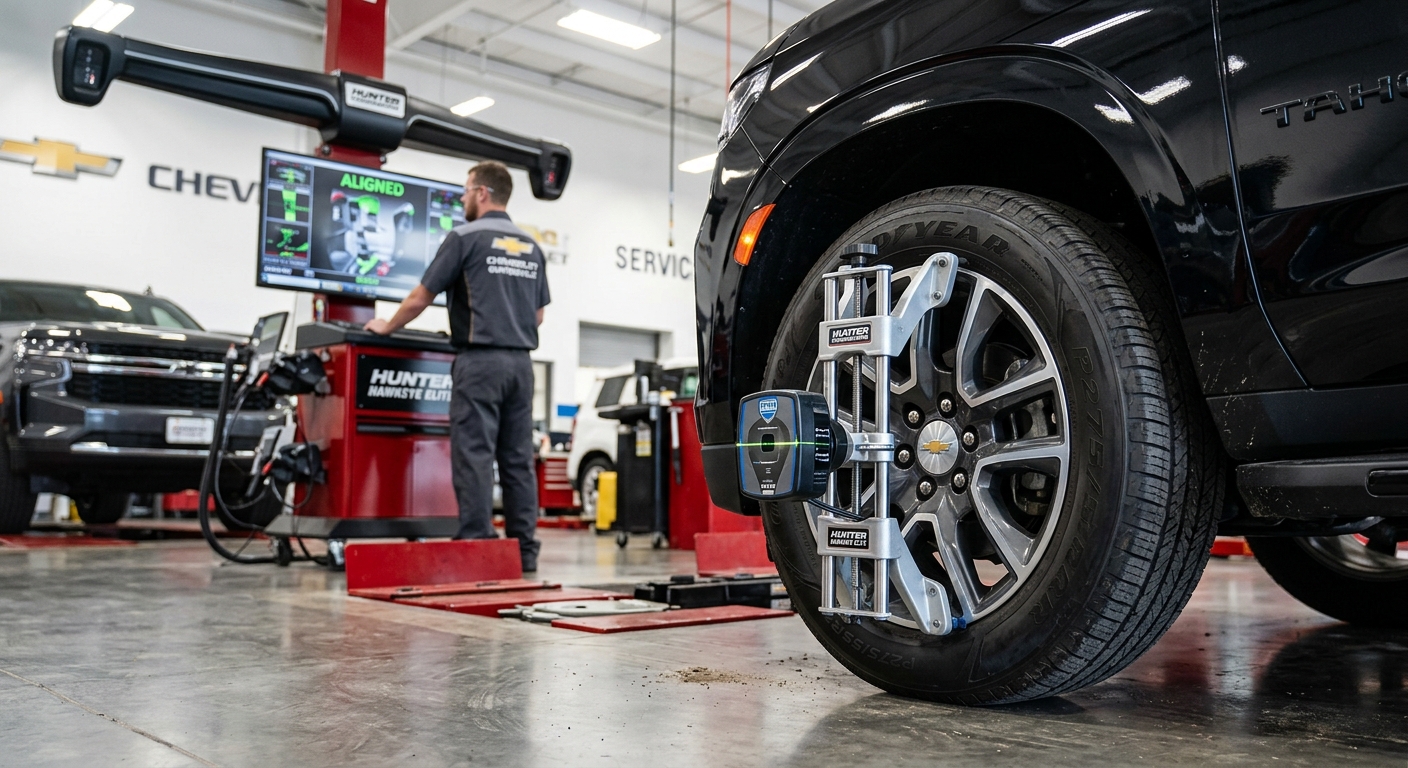
Understanding How Often Your Chevrolet Needs a Wheel Alignment
While a yearly check is a reliable baseline, driving habits and local road conditions dictate whether you need an adjustment sooner. If your daily commute involves navigating construction zones, rough asphalt, or unavoidable potholes, scheduling an inspection every six months is a safer approach. When you are ready to plan your next visit, you can look up our convenient location or give our service desk a quick call to speak with an advisor. Before coming in, it is always a good idea to check our current Chevrolet special offers to see if we have any active maintenance discounts.
Table of Contents
- Identifying the Clear Signs That Your Chevy Needs an Alignment Check
- The Science of Suspension Angles and Tire Tread Protection
- Specialized Alignment Needs for Chevrolet Trucks and Towing Vehicles
- Comparing Wheel Alignment and Tire Balancing for Optimal Ride Quality
- Protecting Your Tire Investment with Professional Chevrolet Service
Identifying the Clear Signs That Your Chevy Needs an Alignment Check
A vehicle rarely loses its alignment overnight without some kind of warning sign. One of the most obvious indicators of misalignment is a persistent pull to one side when you are trying to drive straight. If you temporarily relax your grip on the steering wheel on a flat road and the vehicle immediately drifts left or right, the suspension geometry is likely out of spec. Drivers navigating agricultural roads or hauling trailers around Rainsville frequently encounter uneven dirt paths and deep ruts that can knock wheels out of alignment instantly, resulting in a crooked steering wheel even when traveling in a straight line.
Another critical warning sign is uneven tire wear, which often shows up as rapid tread loss on either the inner or outer edge of the tire. This pattern, known as feathering, drastically shortens the lifespan of your tires and reduces overall fuel efficiency. Our team is dedicated to helping drivers maintain safe vehicles, a commitment we share through community initiatives like our local support programs. If you notice these symptoms and decide it is time to upgrade your vehicle instead of scheduling repairs, you can browse our pre-owned inventory or use our online tool to value your trade-in.
Engine & Performance
Powertrain specs by trim
| Feature | ACTIV | LT | RS |
|---|---|---|---|
| Engine | 1.5L | 1.5L | 1.5L |
| Horsepower | 175 hp | 175 hp | 175 hp |
| Torque | 184 lb-ft | 184 lb-ft | 184 lb-ft |
| Transmission | CVT | CVT | CVT |
| Drivetrain | Front-wheel drive | Front-wheel drive | Front-wheel drive |
The Science of Suspension Angles and Tire Tread Protection
Suspension geometry relies on three primary angles to keep your tires flat against the pavement. The first critical measurement is camber, which refers to the inward or outward tilt of the tire when viewed directly from the front of the vehicle. If the top of the tire tilts too far inward, it causes negative camber, while an outward tilt represents positive camber. In a properly aligned vehicle, camber should place the tire approximately perpendicular to the road surface when viewed from the front, helping ensure maximum tread contact and even tire wear.
The second angle is toe, which represents the direction the tires point relative to the vehicle’s centerline when viewed from directly above. When tires point inward toward each other, it is called toe-in, whereas pointing outward is toe-out, both of which cause rapid tread scrubbing. Finally, caster is the angle of the steering pivot when viewed from the side, which plays a major role in high-speed stability and steering wheel self-centering. Adjusting these three angles requires specialized diagnostic equipment and certified technicians. To experience our commitment to quality service firsthand, you can read our customer testimonials, use our online service scheduling tool, or complete our secure credit application if you are planning major vehicle upgrades.
Specialized Alignment Needs for Chevrolet Trucks and Towing Vehicles
Towing a heavy trailer or hauling payloads completely transforms how a vehicle’s suspension behaves under pressure. When a vehicle carries heavy rear loads, the rear suspension compresses, which naturally lifts the front end and alters the steering geometry. This shift changes the caster and toe angles, directly affecting steering responsiveness and highway stability. For example, a three-row SUV like the 2026 Chevrolet Traverse LT, which features a 2.5L engine producing 328 hp and 326 lb-ft of torque, is rated to tow up to 5,000 lbs when properly equipped. If you frequently tow near this capacity, regular alignment checks are crucial to ensure the vehicle remains stable and predictable at highway speeds.
Similarly, daily drivers require precise alignment to maintain their factory-rated efficiency and handling. The 2026 Chevrolet Equinox LT utilizes a 1.5L engine, a CVT transmission, and a standard Front-wheel drive system to achieve an efficient 26 city / 29 hwy mpg. Misaligned wheels increase rolling resistance, which forces the engine to work harder and directly degrades these fuel economy figures. When drivers bring their vehicles to our service bays, they often ask if a front-end alignment is cheaper than a full four-wheel alignment, especially when trying to save on routine maintenance. While a front-end alignment may carry a lower initial cost, modern Chevrolet models require a comprehensive four-wheel alignment to protect the advanced steering and safety systems. If you are interested in exploring our full lineup, you can shop our new Chevrolet Traverse inventory, view the new Chevrolet Equinox models, or check out the rugged new Chevrolet Silverado 1500 trucks.
Comparing Wheel Alignment and Tire Balancing for Optimal Ride Quality
Many drivers confuse wheel alignment with tire balancing, assuming that resolving a steering vibration automatically requires a suspension adjustment. While both services are essential for a smooth ride, they address entirely different mechanical issues. Wheel alignment focuses on adjusting the physical angles of the steering and suspension components so the tires make proper contact with the road. In contrast, tire balancing corrects uneven weight distribution within the tire and wheel assembly itself, which is achieved by attaching small weights to the wheel rim.
Unbalanced tires typically cause a distinct vibration in the steering wheel or seat that intensifies at highway speeds. Misalignment, on the other hand, is characterized by the vehicle pulling to one side or uneven tire wear without necessarily causing a vibration. If you need to replace tires that have worn out due to long-term misalignment, you can shop new tires online through our store. You can also customize your vehicle’s look and utility by visiting our accessories ordering page, or start the buying process by applying for credit online.
Protecting Your Tire Investment with Professional Chevrolet Service
Securing the longevity of your tires comes down to precise maintenance and professional oversight. Our certified service center utilizes state-of-the-art diagnostic machines to measure alignment angles down to a fraction of a degree. This level of precision is impossible to replicate at home, making professional service the only reliable way to protect your tire investment. For example, protecting the suspension setup on a vehicle like the Equinox LT, which has a Base MSRP of $28,800 and a Destination charge of $1,995, ensures you get the maximum value and safety out of your daily driver.
When you install a new set of tires, getting an immediate wheel alignment check is highly recommended to prevent premature wear from the very first mile. Our technicians will inspect your entire suspension system, adjust the angles to factory specifications, and ensure your vehicle handles exactly as the manufacturer intended. If you need replacement suspension components or official hardware, you can order directly from our parts ordering page. For hands-on assistance, stop by our service department at our Guntersville location or contact our service advisors by calling (256) 578-9170 today.
### Pricing
*Pricing by trim*
| Feature | ACTIV | LT | RS |
|---|---|---|---|
| Base MSRP | $33,600 | $28,800 | $33,600 |
| Destination charge | $1,995 | $1,995 | $1,995 |
0 comment(s) so far on What I Tell Our Customers About Chevrolet Wheel Alignment Intervals