


What Does the Difference Between Dealer Retail Value and Trade-In Value Tell You About Your Deal?
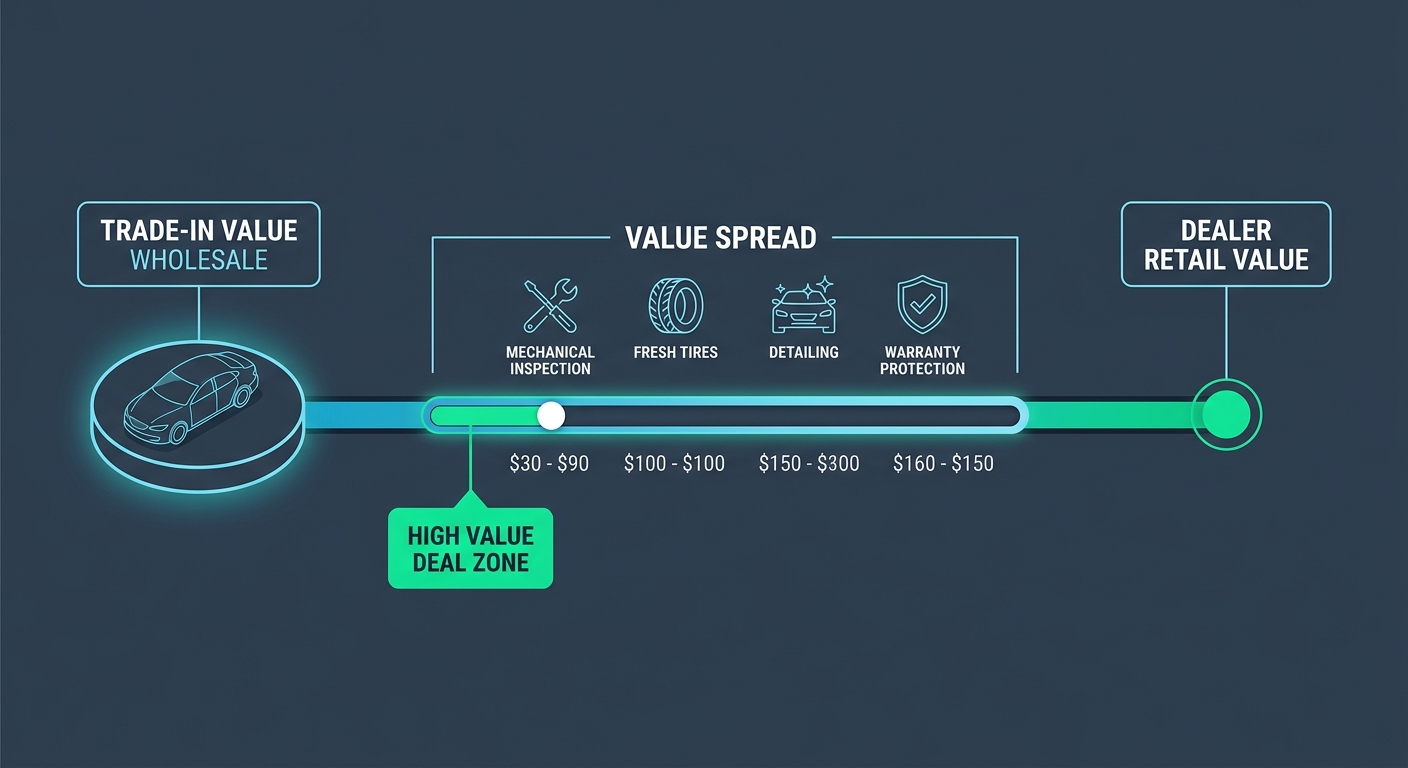
The difference between dealer retail value and trade-in value on your used vehicles measures the market spread required to recondition, inspect, certify, and market a pre-owned vehicle. If your final purchase price sits closer to wholesale trade-in value than public retail pricing, you successfully negotiated a discount below standard dealer margins; if your price lands at or above average retail, you paid full market rate for dealer preparation and administrative overhead.
  +-----------------------------------------------------------------------+
  |                        PRE-OWNED MARKET SPREAD                        |
  +-----------------------------------------------------------------------+
  |  [ Trade-In Value ]  -->  Reconditioning, Warranty,  -->  [ Retail  |
|  (Wholesale Baseline)     Inspection, & Service Costs      Price ]    |
  +-----------------------------------------------------------------------+
Understanding this pricing gap gives you clear context when evaluating a vehicle purchase. Trade-in value represents what a dealership pays to acquire a vehicle in its current condition. Dealer retail value reflects the vehicle’s asking price after comprehensive mechanical servicing, detailed exterior reconditioning, local safety compliance checks, and built-in warranty protection. The spread between these two figures accounts for real reconditioning costs—such as mounting fresh tires, servicing worn brakes, changing fluids, and rectifying open mechanical issues—alongside required operational overhead.
When you evaluate pre-owned pricing, analyzing where your negotiated price falls within this spread reveals the true value of your deal:
- Pricing Near Trade-In Value: Acquiring a vehicle near wholesale trade-in pricing means you secured an aggressive deal, often leaving minimal gross profit margin for the seller.
- Pricing Mid-Way in the Spread: Paying near the midpoint between wholesale trade-in and retail asking price represents a balanced market deal where reconditioning expenses are accounted for without excessive retail markup.
- Pricing Near Retail Asking Price: Purchasing near the top of the retail market means you paid full retail margin, which should strictly coincide with low-mileage condition, complete service records, or factory-backed warranty coverage.
Shoppers evaluating local options around the Lake Guntersville reservoir often balance towing capacity and vehicle condition against asking price. To begin evaluating your trade or reviewing current market spreads, you can value your trade online with our online tool. If you want expert assistance analyzing market listings, stop by our Guntersville showroom location or give our team a quick call at (256) 578-9170.
Table of Contents
- What Essential Features and Mechanical Components Should You Inspect on a Used Vehicle?
- How Do You Spot Signs of Structural or Frame Damage Before Buying?
- How Do Safety Recalls Work on Used Vehicles and Who Pays for Repairs?
- How Do You Maintain Your Used Vehicle for Long-Term Dependability?
- Common Questions About Used Vehicle Valuation, Recalls, and Maintenance
- Navigating Used Vehicle Ownership with Confidence
What Essential Features and Mechanical Components Should You Inspect on a Used Vehicle?
A comprehensive pre-purchase physical inspection must evaluate structural alignment, tire tread depth, air conditioning compressor operation, fluid clarity, and diagnostic fault codes across all primary mechanical systems. Verifying these components before taking delivery prevents immediate post-purchase repair expenses and ensures long-term operational dependability.
  +-----------------------------------------------------------------------+
  |                    PRE-PURCHASE INSPECTION STEPS                      |
  +-----------------------------------------------------------------------+
  |  [1. Exterior Panels] -> [2. HVAC Output] -> [3. Mechanical Diagnostics] |
|  Check alignment gaps    Test max cooling    Scan diagnostic codes    |
  +-----------------------------------------------------------------------+
When buyers walk through a pre-purchase inspection on our lot, they most often ask how to verify that active driver assistance systems like lane-keep assist actually engage during the road test before looking at cosmetics. Beyond advanced cabin electronics, systematic mechanical checks should follow a standardized sequence:
- HVAC and Climate Control: Turn the air conditioning system to its maximum cooling setting. The system should blow cold air within a few minutes while the engine bay remains free of unusual compressor clatter or belt squeal.
- Exterior Panel and Glass Alignment: Inspect the gaps between doors, fenders, trunk lids, and hood lines. Inconsistent spacing or paint color mismatches signal previous body repair work.
- Tire Condition and Tread Uniformity: Check tread depth across the full width of all four tires. Uneven edge wear indicates misaligned steering geometry or worn suspension bushings.
- Under-Hood Mechanical Diagnostic: Examine engine oil, transmission fluid, and brake fluid for proper fill level and clarity. Run a diagnostic scanner through the OBD-II port to confirm no hidden trouble codes are stored in the engine control module.
When cross-shopping vehicle categories, understanding powertrain configurations helps narrow your search. For example, a 2026 Chevrolet Equinox built with the 1.5L engine delivers 175 hp across all configurations. Front-wheel-drive models such as the LT 1.5T, RS 1.5T, and ACTIV 1.5T utilize a smooth CVT generating 184 lb-ft of torque. Upgrading to all-wheel-drive variants like the AWD LT 1.5T, AWD RS 1.5T, or AWD ACTIV 1.5T pairs that same engine with a Hydra-Matic 8-speed automatic transmission, boosting engine torque output to 203 lb-ft for enhanced traction.
If you are comparing brand-new crossovers against pre-owned options, feel free to browse our new Chevrolet vehicle selection, explore factory-backed options in our certified pre-owned vehicle inventory, or source replacement filters through our genuine GM parts ordering center.
Engine & Performance
Powertrain specs by trim
| Feature | ACTIV 1.5T | AWD ACTIV 1.5T | AWD LT 1.5T | AWD RS 1.5T | LT 1.5T | RS 1.5T |
|---|---|---|---|---|---|---|
| Engine | 1.5L | 1.5L | 1.5L | 1.5L | 1.5L | 1.5L |
| Horsepower | 175 hp | 175 hp | 175 hp | 175 hp | 175 hp | 175 hp |
| Torque | 184 lb-ft | 203 lb-ft | 203 lb-ft | 203 lb-ft | 184 lb-ft | 184 lb-ft |
| Transmission | CVT | Hydra-Matic | Hydra-Matic | Hydra-Matic | CVT | CVT |
| Drivetrain | Front-wheel drive | All-wheel drive | All-wheel drive | All-wheel drive | Front-wheel drive | Front-wheel drive |
How Do You Spot Signs of Structural or Frame Damage Before Buying?
Signs of structural frame damage on a pre-owned vehicle include uneven body panel gaps, doors that bind when opening, fresh welding marks along frame rails, and persistent steering pull during a road test. Identifying chassis distortion before purchase protects you from buying a compromise vehicle with compromised safety geometry.
Frame integrity dictates how a vehicle absorbs impact energy in a collision and maintains wheel alignment on the road. During your visual walkaround, focus on structural connection points beneath the body shell:
- Undercarriage Frame Rails: Look under the chassis with a flash light for fresh undercoating sprayed over rust, non-factory welding seams, or clamp marks caused by frame-straightening machines.
- Door and Hood Closure Flushness: Open and close every door, the hood, and the rear tailgate. Panels that catch, drag, or require physical force to latch flush suggest structural misalignment.
- Under-Hood Strut Towers: Inspect the strut towers inside the engine bay. Wrinkled metal, cracked seam sealer, or chipped paint around mounting bolts reveal prior chassis stress.
- Straight-Line Tracking: Drive the vehicle on a flat, straight road segment. If the vehicle pulls hard to one side or the steering wheel sits off-center while traveling straight, unrectified frame damage may be present.
Resolving purchase details before taking delivery ensures a seamless ownership transition. You can complete our secure online financing application prior to your visit, or customize your vehicle’s cargo layout through our official Chevrolet accessories portal.
Pricing
Pricing by trim
| Feature | ACTIV 1.5T | AWD ACTIV 1.5T | AWD LT 1.5T | AWD RS 1.5T | LT 1.5T | RS 1.5T |
|---|---|---|---|---|---|---|
| Base MSRP | $33,600 | $35,600 | $30,800 | $35,600 | $28,800 | $33,600 |
| Destination charge | $1,995 | $1,995 | $1,995 | $1,995 | $1,995 | $1,995 |
How Do Safety Recalls Work on Used Vehicles and Who Pays for Repairs?
Vehicle manufacturers are required by law to cover 100% of parts and labor costs for safety recall repairs performed at authorized franchise dealerships. Open safety recalls carry no expiration date for vehicles within 15 years of their original purchase date, ensuring pre-owned buyers receive free factory repairs regardless of vehicle age or owner history.
  +-----------------------------------------------------------------------+
  |                        SAFETY RECALL PROCESS                          |
  +-----------------------------------------------------------------------+
  |  [ Locate 17-Digit VIN ] -> [ Lookup Recall Status ] -> [ Free Repair ] |
|  Found on dashboard        Check official database      At dealer     |
  +-----------------------------------------------------------------------+
While federal law prohibits franchise dealers from selling brand-new vehicles with uncompleted safety recalls, federal regulations do not restrict used vehicle sales with active recalls. Responsible dealerships proactively clear open safety recalls during the intake and reconditioning process before putting pre-owned inventory up for sale.
To verify open recall status on any vehicle independently, follow these simple verification steps:
- Locate the unique 17-digit Vehicle Identification Number (VIN) stamped on the driver-side dashboard corner or door pillar sticker.
- Input the VIN into the official NHTSA recall lookup database or manufacturer owner portal.
- Review any active campaign notices detailing affected components, potential safety risks, and repair availability.
- Contact an authorized franchise dealer to schedule a complimentary service appointment if an open recall is identified.
Commuters navigating daily drives along the Sand Mountain plateau near Albertville count on complete mechanical dependability. Whether you choose a compact sedan or a spacious 3-row crossover, exploring our verified pre-owned vehicle inventory ensures your next vehicle has undergone rigorous multi-point safety checks.
Fuel Economy
Fuel economy and range by trim
| Feature | ACTIV 1.5T | AWD ACTIV 1.5T | AWD LT 1.5T | AWD RS 1.5T | LT 1.5T | RS 1.5T |
|---|---|---|---|---|---|---|
| MPG | 26 city / 29 hwy / 27 combined | 25 city / 29 hwy / 26 combined | 25 city / 29 hwy / 26 combined | 25 city / 29 hwy / 26 combined | 26 city / 29 hwy / 27 combined | 26 city / 29 hwy / 27 combined |
How Do You Maintain Your Used Vehicle for Long-Term Dependability?
Maintaining long-term reliability in a pre-owned vehicle requires adhering to factory scheduled service intervals, utilizing accurate fluid monitoring technology, and addressing minor wear items promptly. Most modern Chevrolet models follow a consistent 7,500-mile routine maintenance rhythm to protect vital powertrain components.
  +-----------------------------------------------------------------------+
  |                     Chevrolet SERVICE RHYTHM                          |
  +-----------------------------------------------------------------------+
  |  7,500 Miles   : Oil & Filter Change, Tire Rotation, Brake Check      |
|  22,500 Miles  : Cabin Air Filter Replacement                         |
|  45,000 Miles  : Engine Air Filter & Brake Fluid Replacement          |
|  97,500 Miles  : Spark Plug Service                                   |
  +-----------------------------------------------------------------------+
Built-in diagnostics streamline ownership care. Chevrolet’s Oil Life Monitoring System continuously calculates engine operating temperatures, revs, and driving habits to alert drivers within 600 miles of an impending service requirement. Standard service visits under normal operating conditions occur roughly every 7,500 miles or 12 months.
Key maintenance milestones include:
- 7,500-Mile Interval: Replace engine oil and filter, rotate all four tires to promote even tread wear, inspect brake pads and rotors, test battery health, and top off essential operating fluids.
- 22,500-Mile Interval: Replace the cabin air filter to maintain clean interior HVAC airflow and defrosting efficiency.
- 45,000-Mile Interval: Install a new engine air filter and perform a complete brake fluid flush to maintain hydraulic pedal pressure.
- 97,500-Mile Interval: Replace spark plugs and inspect ignition wires to preserve combustion efficiency and engine power output.
Buyers selecting a Certified Pre-Owned Chevrolet receive enhanced warranty protection, including a factory-backed 6-year/100,000-mile powertrain limited warranty measured from the original in-service date, plus a 12-month/12,000-mile bumper-to-bumper limited warranty, both featuring a $0 deductible. CPO coverage also includes two complimentary maintenance visits within the first 2 years or 24,000 miles, covering engine oil changes, tire rotations, and multi-point inspections. Furthermore, owners enjoy 24-hour Chevrolet Roadside Assistance at 1-800-243-8872 throughout the powertrain warranty term, covering flat-tire changes, fuel delivery, battery jump-starts, and towing service. Managing these services is effortless through the myChevrolet smartphone app, which displays live oil life percentages and maintenance alerts directly on your device.
Common Questions About Used Vehicle Valuation, Recalls, and Maintenance
Q: How does trade-in value differ from dealer retail value?
Trade-in value represents the wholesale price a dealership pays to acquire a vehicle in its existing condition before reconditioning. Dealer retail value reflects the final asking price after the vehicle undergoes multi-point mechanical inspections, safety repairs, body reconditioning, fluid services, and marketing. The spread between trade-in and retail accounts for these necessary reconditioning expenses, administrative overhead, and seller margin.
Q: Who is responsible for paying for safety recall repairs on a pre-owned vehicle?
The vehicle manufacturer covers 100% of parts and labor costs for all official safety recall repairs. Pre-owned owners can take their vehicle to any authorized franchise dealership representing that make to receive free recall servicing, provided the vehicle is within 15 years of its original sale date.
Q: What warranty coverage comes standard with a Certified Pre-Owned Chevrolet?
Chevrolet Certified Pre-Owned models feature a 6-year/100,000-mile powertrain limited warranty from the original in-service date and a 12-month/12,000-mile bumper-to-bumper limited warranty. Both warranties carry a $0 deductible and include 24-hour roadside assistance, towing benefit coverage, and two complimentary scheduled maintenance visits within 2 years or 24,000 miles.
Q: How does the myChevrolet app assist with post-purchase vehicle ownership?
The myChevrolet smartphone app connects directly to your vehicle’s onboard diagnostics to display real-time engine oil life percentages, tire pressure readings, and maintenance notifications. Pre-owned owners can track service history, request emergency roadside assistance, and schedule routine maintenance appointments directly from their phone.
Q: What are the base MSRP figures for popular crossover trim levels like the Equinox?
Starting pricing for the 2026 Chevrolet Equinox lineup begins with the LT 1.5T at $28,800 base MSRP and the AWD LT 1.5T at $30,800. The sporty RS 1.5T starts at $33,600, while the AWD RS 1.5T is priced at $35,600. The off-road-inspired ACTIV 1.5T starts at $33,600, with the AWD ACTIV 1.5T reaching $35,600. Every trim carries a standardized $1,995 destination charge.
When you are ready to book routine service, schedule via our online service scheduling tool, read more about our dealership team, or explore our involvement in community awareness initiatives.
Navigating Used Vehicle Ownership with Confidence
Mastering pre-owned vehicle ownership comes down to understanding market values, completing thorough physical inspections, verifying recall clearances, and following factory maintenance rhythms. By evaluating the spread between wholesale trade-in values and retail pricing, you gain complete clarity on the financial fairness of your purchase.
Our team is dedicated to supporting your ownership journey with factory-certified technicians, transparent vehicle histories, and dependable ongoing service care. To take the next step, explore our online inventory, drop by Guntersville showroom location, or contact our sales and service departments directly by calling (256) 578-9170 today.
0 comment(s) so far on What Does the Difference Between Dealer Retail Value and Trade-In Value Tell You About Your Deal?