


The Real Deal on Tire Rotation: How Swapping Positions Maximizes Your Tread Life
Why Regular Tire Rotation Matters on Guntersville Roads
Our service department regularly helps drivers establish a consistent maintenance routine to prevent this costly imbalance. We generally recommend scheduling a tire rotation every 5,000 to 7,500 miles, which conveniently aligns with your standard oil change interval. By keeping up with this simple service, you ensure that all four tires wear down at a uniform rate, allowing you to eventually replace them as a complete, balanced set. If you are noticing uneven wear or if it has been a while since your last service, you can easily book an appointment using our online service scheduler.
When tires wear out at different times, it forces you to make a tough choice between buying a mismatched pair or replacing all four prematurely. Mismatched tires can compromise your handling and stability, especially when navigating wet lakeside boat ramps. If you would like to speak directly with our service advisors about your vehicle’s specific tire wear, you can give our team a quick call. For those who prefer to drop by and speak to an expert in person, our Guntersville showroom is a highly convenient location to visit.
Table of Contents
- Understanding Front-Wheel Drive and Rear-Wheel Drive Rotation Patterns
- How All-Wheel Drive and Four-Wheel Drive Systems Wear Tires Differently
- Managing Directional Tires and Staggered Wheel Setups
- The Technical Benefits of Even Tread Wear on Your Fuel Economy and Warranty
- Expert Tire Care and Professional Maintenance
Understanding Front-Wheel Drive and Rear-Wheel Drive Rotation Patterns
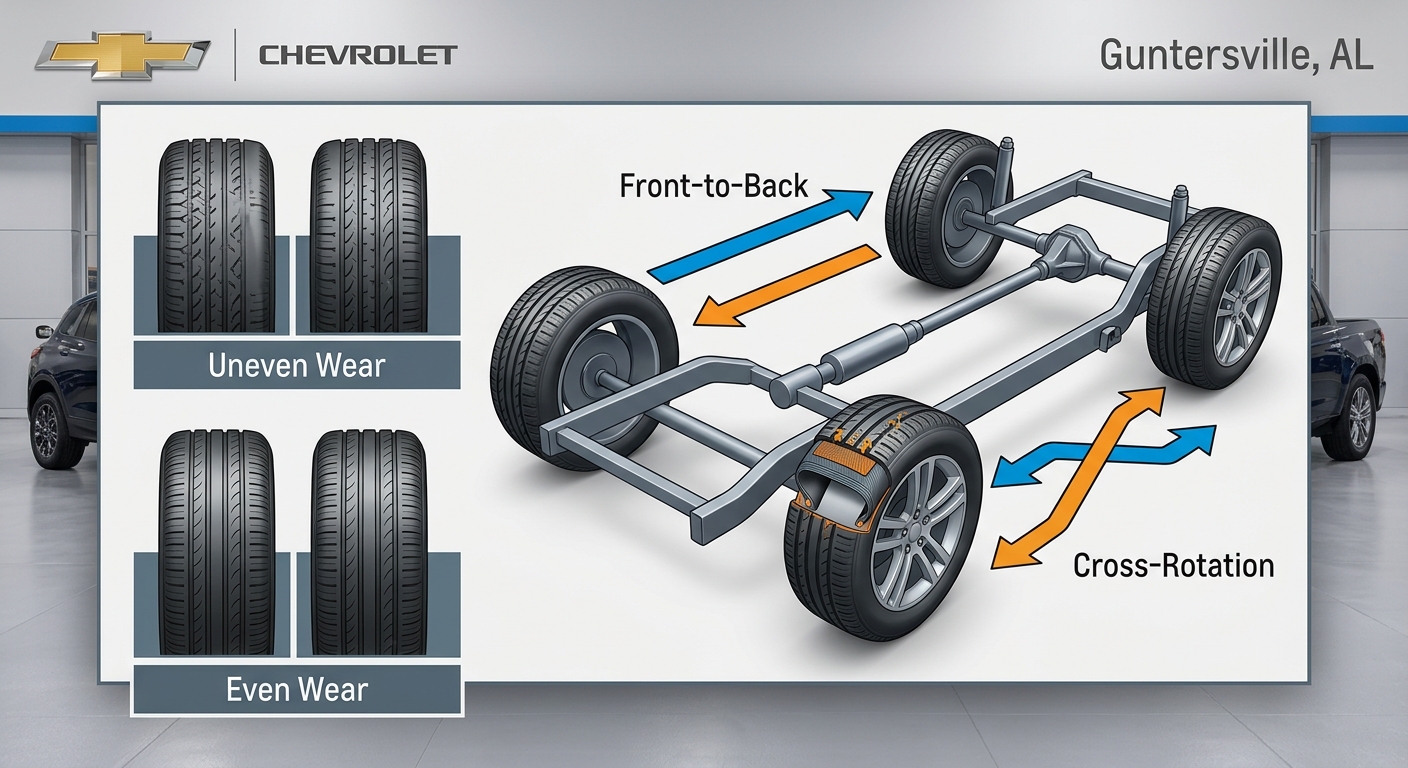
Let’s talk about how power delivery directly dictates your vehicle’s tire rotation pattern. In a front-wheel-drive vehicle, the front tires are responsible for power delivery, steering, and the majority of braking, which means they wear out significantly faster than the rear tires. To combat this, technicians use a forward cross rotation pattern. In this specific configuration, the front tires move directly straight back to the rear axle. The rear tires, however, cross over to the opposite sides when they move up to the front axle, meaning the left rear tire moves to the front right position, and the right rear tire moves to the front left position.
Rear-wheel-drive vehicles require the exact opposite approach because the rear axle handles the acceleration forces while the front axle manages the steering. For these setups, we utilize a rearward cross pattern. The rear tires are moved straight forward to the front axle. Meanwhile, the front tires cross over as they move to the back, with the front left tire heading to the rear right position, and the front right tire moving to the rear left position. This ensures that the directional wear from steering is countered by the straight-line wear of the drive axle.
This fundamental difference in power delivery is why we always check a vehicle’s drivetrain before beginning any service. For example, if you are driving a front-wheel-drive model like the ACTIV or LT trims of the 2026 Chevrolet Equinox, which comes standard with a 1.5L engine and a CVT, your tires will follow the forward cross pattern. If you want to experience how different drivetrains handle on the road, you can explore Chevrolet models online or schedule a test drive. For those interested in the latest electric vehicle technology, you can also schedule an EV test drive to see how instant electric torque impacts tire traction. If you need a rugged, body-on-frame midsize truck, you can shop the new Chevrolet Colorado to find a vehicle built for both daily commuting and weekend trail riding.
How All-Wheel Drive and Four-Wheel Drive Systems Wear Tires Differently
Now, when it comes to all-wheel-drive and four-wheel-drive systems, tire wear becomes even more complex. Because these systems can send power to all four corners, every single tire experiences acceleration forces, but they still do not wear out evenly. The front tires still have to handle steering and a larger portion of the braking weight transfer. In these vehicles, a minor difference in tread depth between the front and rear axles can actually place mechanical strain on your transfer case and center differential, as the system tries to compensate for tires spinning at slightly different speeds.
For these drivetrains, we typically utilize a rearward cross pattern, similar to rear-wheel-drive vehicles, though some manufacturers also approve an X-pattern where all four tires cross diagonally to the opposite corners. Maintaining perfectly matched tread depth is so critical for all-wheel-drive systems that even the spare tire must be managed carefully. If you have a matching, full-size spare, we can perform a five-tire rotation. This process systematically integrates the spare into the rotation loop, ensuring all five tires wear down at the exact same rate so that you never risk damaging your drivetrain if you have to put the spare into service.
This level of precision is especially important for heavy-duty work trucks and high-torque electric vehicles. If you are hauling heavy loads around Albertville, you know how much strain towing puts on your rear axle. For those managing demanding jobs, you can shop the new Chevrolet Silverado HD to find a truck engineered to handle maximum payload capacity. If you are looking for an efficient, high-performance electric SUV, you can shop the new Chevy Blazer EV to experience dual-motor power. Alternatively, if you want a compact and practical electric option for daily driving, you can shop the new Chevrolet Bolt EUV to enjoy efficient commuter driving.
Managing Directional Tires and Staggered Wheel Setups
Another important thing to know about tire rotation is that not all tires can be crossed from side to side. Directional tires are designed with a specific tread pattern that must face forward to properly channel water away and maintain grip. These tires have arrows on the sidewall indicating their required direction of rotation. Because they cannot spin backward, they can only be rotated straight front-to-back on the same side of the vehicle. Crossing a directional tire to the opposite side of the vehicle would cause the tread to run backward, severely reducing wet weather traction and increasing road noise.
Staggered wheel setups present a different challenge because the rear wheels and tires are physically wider than the front ones. This design is common on high-performance sports cars to maximize rear-wheel traction. Because you cannot put the wide rear tires on the front axle, a standard front-to-back rotation is impossible. If the tires are non-directional, we can rotate them side-to-side across the same axle. However, if the vehicle features both staggered wheels and directional tires, they cannot be rotated at all without dismounting the rubber from the wheels, flipping them, and rebalancing them.
Most family SUVs and commercial vans utilize symmetrical, non-directional tires, which makes routine maintenance much more straightforward. For families needing maximum interior space and seating for up to eight, you can shop the new Chevrolet Suburban to accommodate large group trips. If you need a highly maneuverable five-passenger crossover, you can shop the new Chevrolet Equinox, which offers about 30 cu ft of cargo space behind the second row. For business owners looking to optimize their fleet logistics, you can shop the new Brightdrop 400 inventory to find an all-electric commercial delivery van designed for maximum productivity.
The Technical Benefits of Even Tread Wear on Your Fuel Economy and Warranty
Here’s what you need to know about the financial and performance benefits of keeping your tires rotated. When tires wear unevenly, they develop flat spots, cupping, or feathered edges along the tread blocks. This uneven surface increases rolling resistance, which means your engine has to burn more fuel just to push the vehicle down the highway. By keeping the tread wearing smoothly and evenly across all four wheels, you minimize this friction and optimize your fuel economy.
Furthermore, skipping your regular tire rotations can completely void your tire warranty. Most major tire manufacturers require documented proof of regular tire rotations—typically every 5,000 to 7,500 miles—to honor mileage treadwear warranties. If you experience premature wear but cannot show receipts proving the tires were rotated on schedule, you will likely have to pay full price for your replacement set. Even wear also ensures that your safety systems, such as anti-lock brakes and electronic stability control, can calibrate correctly based on consistent grip levels at all four corners.
Our service team has helped countless drivers protect their investments and maintain their vehicle warranties. If you want to see how we treat our guests, you can read customer testimonials from local vehicle owners who trust us with their maintenance. For those looking for a spacious three-row family vehicle with plenty of towing capability, you can shop the new Chevrolet Tahoe to find a highly versatile SUV. If you prefer a sporty, midsize option with aggressive styling, you can shop the new Chevrolet Blazer to stand out on your daily drive.
Expert Tire Care and Professional Maintenance
One thing I always tell customers about tire maintenance is that rotation is only one part of the equation. Every time we rotate your tires, our certified technicians also inspect the tread depth, check for unusual wear patterns that might indicate an alignment issue, and adjust your tire pressure to the manufacturer’s recommended specifications. For drivers navigating the rural roads around Crossville, keeping your suspension aligned and your tires properly inflated is crucial for handling gravel surfaces and avoiding punctures.
If you ever experience a sudden tire issue on the road, remember that new Chevrolet vehicles come with manufacturer-backed roadside assistance. This program connects you with certified experts who can assist with flat tire changes, towing, and emergency services using genuine parts. You can reach them directly at Chevrolet Roadside Assistance: 1-800-243-8872. Our dealership is always here to help coordinate your service needs and ensure your vehicle remains covered under its original warranty protection.
If you are ready to have your tires inspected, rotated, or balanced, our team is standing by to provide quick, professional service. You can call our service department directly at (256) 578-9170 to speak with an advisor. When you are ready to visit, you can easily find us and get directions to our service center. If you are looking to upgrade to a highly efficient and modern commuter vehicle, you can also shop the new Chevrolet Bolt to see our latest electric options.
0 comment(s) so far on The Real Deal on Tire Rotation: How Swapping Positions Maximizes Your Tread Life