


Should the service receipt list the rotation pattern used?
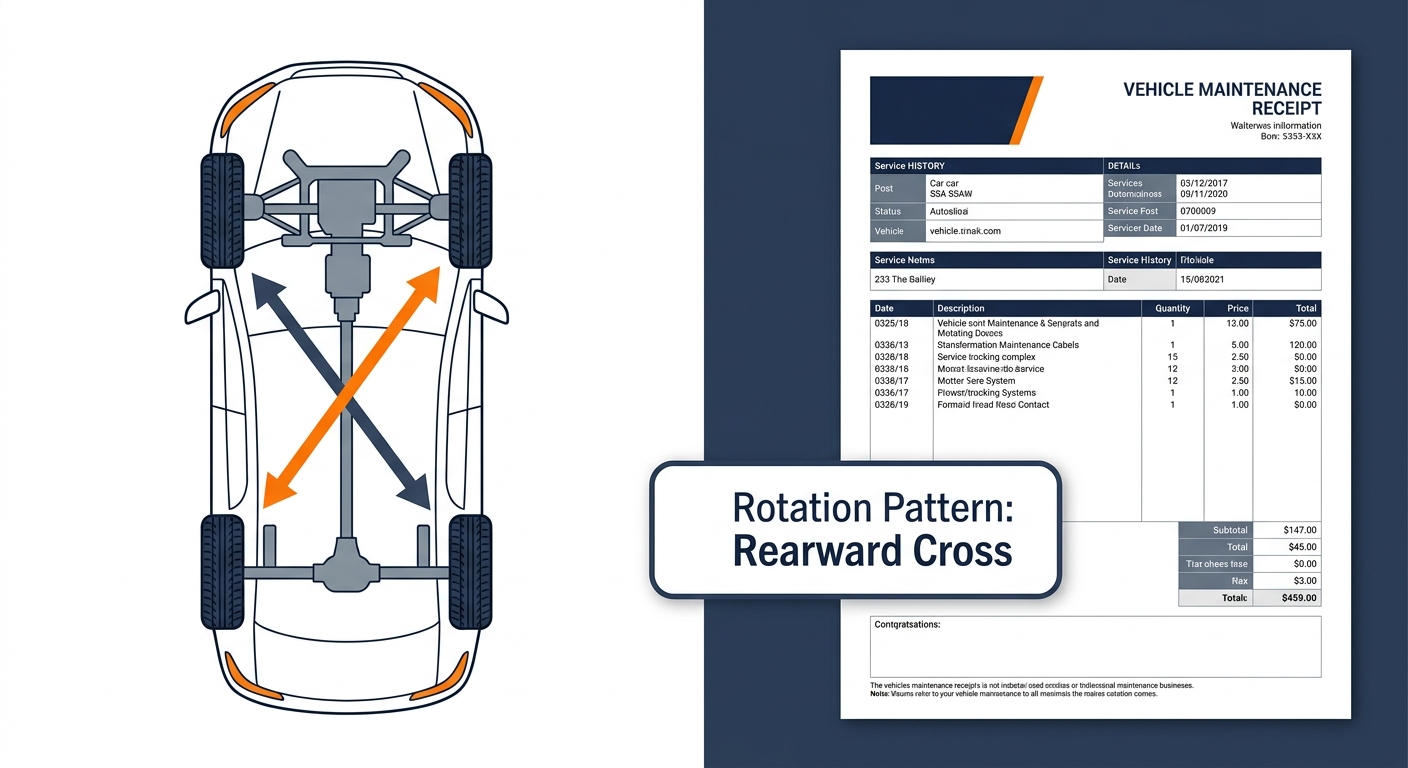
Yes, a service receipt should ideally list the specific tire rotation pattern used, such as Forward Cross or Rearward Cross, to document maintenance history and prevent improper wear sequences during future service. While many service centers list tire rotation as a single line item, recording the exact direction of movement provides proof of proper care and ensures the next technician moves each tire correctly.
Drivers reviewing their maintenance paperwork often ask whether the receipt needs to state which pattern was completed, and while many independent repair facilities summarize the service as a basic line item, explicit documentation provides complete transparency for your vehicle’s service history. Detailed receipts allow vehicle owners to track tread movement across all four positions over time. If a vehicle exhibits uneven tread depth later, having the recorded rotation strategy on file helps technicians identify potential suspension misalignment, improper inflation pressures, or drivetrain issues.
Having detailed service receipts becomes especially valuable when evaluating warranty claims or selling a vehicle. Tire manufacturers often require documented proof of periodic tire rotations at specified mileage intervals to honor treadwear warranties. A receipt that explicitly identifies the pattern used offers clear proof that maintenance followed recommended engineering guidelines. For pre-owned buyers evaluating a pre-owned vehicle inventory listing, comprehensive receipts demonstrating routine, documented tire care serve as evidence of diligent overall vehicle upkeep.
Our factory-trained service team records detailed service notes during every tire maintenance visit. If you want to discuss your vehicle’s specific tire wear or request a detailed record for your maintenance log, you can reach our team directly at (256) 578-9170 or visit us at our Guntersville location for complete tire care assistance.
Table of Contents
- How often should you rotate tires based on mileage, time, and drivetrain?
- What are the standard tire rotation patterns for FWD, RWD, AWD, and directional tires?
- What happens if you never rotate your tires or skip scheduled service?
- Professional service vs DIY: Why certified Chevrolet tire maintenance matters
- Frequently Asked Questions About Chevrolet Tire Rotation
- Maintain Your Tires with Dependable Service at Guntersville Chevrolet
How often should you rotate tires based on mileage, time, and drivetrain?
You should rotate your tires every 5,000 to 7,500 miles or at least once every six months, though specific interval requirements vary based on drivetrain configuration and driving conditions. Adhering to this timeframe prevents front or rear tires from developing severe wear patterns before being repositioned.
Drivetrain design directly impacts how quickly and where tread wear accumulates. Front-wheel-drive vehicles place steer, braking, and drive forces entirely on the front axle, causing front tires to wear down significantly faster than rear tires. For these vehicles, sticking strictly to a 5,000 to 7,500 mile schedule is essential. Rear-wheel-drive and full-size trucks like the 2026 Chevrolet Silverado 1500 distribute steering and driving tasks across separate axles, but heavy payloads or towing trailers near Lake Guntersville place extra stress on the rear tires, requiring consistent rotation to equalize tread depth.
Vehicles equipped with all-wheel drive or four-wheel drive demand even stricter attention to tire rotation cadence. Many AWD service guidelines recommend rotating tires every 3,000 to 5,000 miles because even minor differences in tread depth between tires can place strain on transfer cases and mechanical differentials. Keeping tread depths closely matched across all four wheels helps protect complex all-wheel-drive systems from excessive heat and unnecessary wear.
Time is another critical factor for drivers who do not cover high annual mileage. Tires on low-mileage vehicles should still be rotated every six months to prevent flat-spotting and rubber degradation caused by long periods of standing. Following these mileage and calendar benchmarks keeps the tires on your new Chevrolet lineup running smoothly and safely for years to come.
What are the standard tire rotation patterns for FWD, RWD, AWD, and directional tires?
The standard tire rotation pattern depends on whether your vehicle is front-wheel drive, rear-wheel drive, all-wheel drive, or equipped with directional tread designs. Selecting the proper pattern ensures that tread block wear is reversed and distributed evenly across all four tire positions.
Different drivetrain layouts require specific movement paths to maximize tire life:
- Forward Cross (Front-Wheel Drive): The front tires move straight back to the rear on the same side. The rear tires move up to the front axle and cross over to opposite sides (left-rear to right-front, right-rear to left-front).
- Rearward Cross (Rear-Wheel & Four-Wheel Drive): The rear tires move straight forward to the front on the same side. The front tires move to the rear axle and cross over to opposite sides (left-front to right-rear, right-front to left-rear).
- X-Pattern (Alternative for FWD/RWD): All four tires move diagonally across the vehicle. The left-front swaps with the right-rear, and the right-front swaps with the left-rear.
- Side-to-Side (Staggered Fitments): Used on high-performance vehicles where front and rear tire sizes differ, but tread is non-directional. Tires swap sides on the same axle.
- Front-to-Back (Directional Tires): Directional tires feature tread patterns designed to rotate in one direction only. These tires must stay on the same side of the vehicle and swap directly front-to-back.
When vehicles include a full-size matching spare tire, technicians incorporate it into a five-tire rotation sequence. Including the spare ensures all five tires wear down at an equal rate, keeping tread depth uniform if a flat tire requires swapping the spare into regular service.
Understanding these mechanics helps vehicle owners realize why professional service yields better long-term performance. If you are preparing to upgrade your current truck or SUV, you can value your trade online to see how regular maintenance protects your vehicle’s resale value.
What happens if you never rotate your tires or skip scheduled service?
Neglecting tire rotations causes uneven tread wear, reduced road traction, compromised braking performance, and significantly shortened overall tire lifespan. Over time, failing to rotate tires forces you to replace two or four tires far earlier than necessary.
When tires remain in the same position indefinitely, specific wear patterns emerge. Front tires on front-wheel-drive cars develop heavy shoulder wear due to cornering forces and weight distribution. Unrotated tires can also develop cupping or diagonal tread wipe, which creates loud humming noises and severe cabin vibration at highway speeds along the Sand Mountain plateau near Albertville.
Beyond noise and comfort issues, unevenly worn tires compromise vehicle safety in wet conditions. Tires with shallow tread on one axle lose the ability to channel water effectively, increasing the risk of hydroplaning during heavy rainstorms. Furthermore, uneven tread circumference on four-wheel-drive or all-wheel-drive vehicles forces mechanical differentials to work continuously to offset rotational speed differences, potentially causing costly drivetrain damage.
Skipping routine tire maintenance ultimately increases your total cost of vehicle ownership. Premature replacement costs far exceed the modest price of regular rotations. If you are planning for vehicle upkeep or considering a new truck purchase, applying for an online credit application allows you to evaluate manageable budget plans that incorporate ongoing routine service.
Professional service vs DIY: Why certified Chevrolet tire maintenance matters
While rotating tires at home is possible with proper jack stands and torque wrenches, professional certified service guarantees precise equipment calibration, multi-point safety inspections, and expert installation. Professional technicians bring specialized tools and brand-specific knowledge that protect both your tires and your vehicle’s mechanical components.
During a professional service appointment, factory-trained technicians execute critical maintenance steps that go beyond physically moving wheels:
- Precision wheel balancing using digital spin balancers to eliminate high-speed vibrations.
- Exact lug nut torque setting using calibrated torque wrenches to prevent rotor warping.
- Comprehensive tread depth and rubber condition checks to detect hidden internal alignment issues.
- Inflation adjustment according to exact door placard specs (Tire Information Placard guidance).
- Inspection of brake pads, rotors, and suspension components while wheels are removed.
DIY rotations carry risks if done without proper commercial equipment. Lifting heavy full-size SUVs like a 2026 Chevrolet Tahoe using emergency jacks poses safety hazards, and incorrect torque application can damage wheel studs or lead to loose lug nuts on the highway. Professional shops also possess the tools required to re-learn Tire Pressure Monitoring System (TPMS) sensor locations so your dashboard correctly identifies low pressure at each specific wheel position.
Whether you drive a daily commuter or one of our certified pre-owned models, trusting factory-trained experts ensures complete peace of mind. You can conveniently book your appointment through our online service scheduling form or explore options in our tire center catalog if your vehicle is ready for a new set of rubber.
Frequently Asked Questions About Chevrolet Tire Rotation
Q: Can I skip a tire rotation if my tread looks completely even?
No, you should not skip a scheduled tire rotation based on visual inspection alone. Subtle tread depth variations and early shoulder wear patterns are difficult to detect with the naked eye but cause uneven wear over subsequent miles. Following consistent mileage benchmarks prevents damage before it becomes visible or causes severe cabin vibration.
Q: How do directional tires change the standard rotation pattern?
Directional tires feature specialized tread patterns engineered to channel water and maximize grip in one rotation direction. Because of this design, directional tires cannot cross over to opposite sides of the vehicle. They must move straight from the front axle to the rear axle on the same side to maintain proper tread orientation and road safety.
Q: Why does my TPMS light stay on or show the wrong tire after a rotation?
The Tire Pressure Monitoring System (TPMS) relies on individual sensors inside each wheel. When tires are rotated to new positions, the vehicle’s computer must be updated to match each sensor with its new wheel location. If the system is not re-learned after service, low-pressure warnings may indicate the wrong tire position on your instrument cluster display.
Q: Does wheel alignment replace the need for tire rotation?
No, wheel alignment and tire rotation perform two distinct maintenance functions. Wheel alignment adjusts suspension angles to ensure wheels point straight and track true, while tire rotation changes wheel positions to balance wear caused by steering, braking, and drive forces. Both services work together to maximize total tire tread life.
Q: How does tire care support community and dealership values?
Maintaining safe, reliable vehicles reflects a broader commitment to safety and responsibility on local roads. Beyond day-to-day service operations, our team actively supports community wellness through community awareness initiatives and educational outreach. You can learn more about our values and staff on our dealership team background page or order specialized equipment directly through the official Chevrolet accessories portal.
Maintain Your Tires with Dependable Service at Guntersville Chevrolet
Protecting your vehicle’s tires requires consistent maintenance intervals, correct rotation patterns, and precise inflation adjustments. By pairing regular rotations every 5,000 to 7,500 miles with professional vehicle inspections, you ensure maximum traction, quiet road performance, and extended tread life for every journey across North Alabama.
Our certified service team at Guntersville Chevrolet is dedicated to keeping your truck, SUV, or sedan running at peak efficiency. Whether you need a standard tire rotation, precision balancing, or a full multi-point safety inspection, our factory-trained technicians provide thorough, honest service tailored to your vehicle’s specific maintenance schedule.
Take the next step in preserving your tire investment today. Check our dealership map for easy directions to our service department, or call our team at (256) 578-9170 to schedule your upcoming maintenance visit.
0 comment(s) so far on Should the service receipt list the rotation pattern used?