


How Much Does a Wheel Alignment Cost on a Chevrolet?
How Much Does a Wheel Alignment Cost on a Chevrolet?
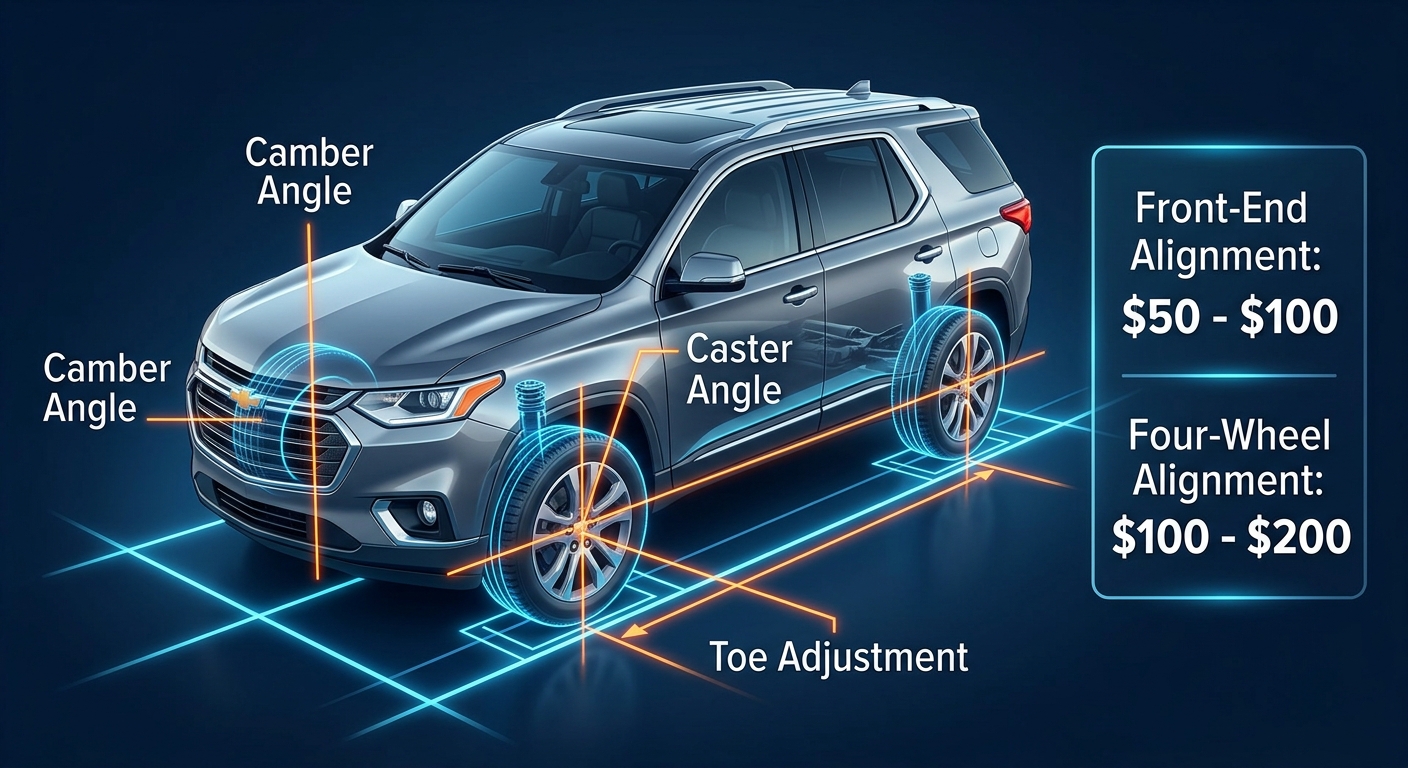
A standard four-wheel alignment on a Chevrolet typically costs between $100 and $200 at a certified dealership service center, with most passenger cars and crossovers averaging $100 to $175. Front-end alignments generally run between $50 and $100, though modern Chevrolet trucks and crossovers require four-wheel service. Final pricing varies depending on suspension design, vehicle size, and whether seized adjustment hardware requires additional shop time.
| Service Type | Average Cost | Recommended Vehicle Application |
|---|---|---|
| Front-End Alignment | $50 – $100 | Older two-wheel-drive models |
| Four-Wheel Alignment | $100 – $200 | Modern Chevy sedans, SUVs, trucks |
| Heavy-Duty & Lifted Alignment | $150 – $250 | Modified trucks & dual-rear-wheel |
Investing in routine alignment inspection protects significant financial investments in vehicle tires. A single set of premium truck or SUV tires can cost $800 to $1,200 or more. Driving on misaligned wheels causes rapid, uneven tread wear on the inner or outer shoulders, often destroying a set of tires in under 10,000 miles. Paying for an alignment preserves the full 50,000-to-70,000-mile tread life potential of your tires, making it one of the most cost-effective preventative maintenance procedures available.
Suspension complexity directly influences the labor involved in setting wheel geometry. Compact cars with simple rear twist-beam axles require less labor time than full-size SUVs equipped with independent rear suspension and electronic driver-assist cameras. On advanced vehicles equipped with lane keep assist or adaptive cruise control, aligning the mechanical steering geometry requires resetting the forward-facing camera alignment to ensure safety systems track accurately.
When planning routine maintenance, drivers can contact our service advisors at (256) 578-9170 to confirm exact service pricing for their specific model year and trim. Our certified technicians utilize factory-calibrated digital laser alignment racks engineered to measure suspension angles to hundredths of a degree. For drivers visiting our Guntersville location, precise factory specifications ensure your vehicle leaves the bay driving as straight and smooth as the day it rolled off the assembly line.
Table of Contents
- How Often Should You Align Your Chevy and What Are the Key Warning Signs?
- Front-End vs. Four-Wheel Alignments and How Alignment Differs From Wheel Balancing
- Proper Wheel Alignment for Chevy Trucks and SUVs Used for Towing
- How Long an Alignment Takes and Ways to Save with Chevy Coupons and MyRewards
- Frequently Asked Wheel Alignment Questions Before You Visit
- Keep Your Chevy Steering Straight
How Often Should You Align Your Chevy and What Are the Key Warning Signs?
Chevrolet vehicles generally require a wheel alignment check every 12,000 to 15,000 miles or once per year under normal driving conditions. Immediate service is necessary if your vehicle drifts off-center, strikes a deep pothole, or contacts a curb hard enough to jolt the steering wheel.
A primary indicator of misaligned steering geometry is a noticeable vehicle pull to one side while traveling on a straight, level road. If maintaining a straight path requires constant steering wheel pressure, the front or rear wheel angles are fighting against each other. Drivers should also inspect the steering wheel emblem while cruising straight; if the center spoke rests at an angle rather than sitting perfectly horizontal, the alignment toe setting requires adjustment.
Tire tread condition offers clear visual evidence of suspension misalignment. Check your tires periodically for these distinct wear patterns:
- Feathering: Tread blocks feel smooth when sliding your hand across the tire in one direction, but rough or sharp when sliding back in the opposite direction.
- Camber Wear: Heavy wear concentrated exclusively on the far inside or far outside edge of the tread face.
- Cupping or Scalloping: Wavy diagonal dips across the tread surface, indicating worn suspension dampers combined with misaligned tracking.
- Squealing Tires: Excessive tire noise during light cornering or low-speed maneuvers in parking structures.
Driving conditions across Marshall County put continuous stress on suspension bushings and steering linkages. Navigating rough agricultural routes and plateau elevation changes around Albertville gradually moves alignment settings out of factory tolerance over time. Striking a single hidden bump during seasonal weather shifts can instantaneously bend a tie rod end or shift a lower control arm cam bolt.
Regular alignment checks coincide perfectly with routine oil changes and tire rotations. Catching slight angle deviations early prevents subtle wear from expanding into severe tread loss. If your current vehicle exhibits abnormal pulling or edge wear, explore our new Chevrolet inventory to see how modern vehicles incorporate chassis stability management. You can also outfit your vehicle for challenging road conditions by exploring heavy-duty floor liners and wheel protection through the GM accessories portal.
Front-End vs. Four-Wheel Alignments and How Alignment Differs From Wheel Balancing
A four-wheel alignment adjusts suspension angles on both front and rear axles and is required for most modern Chevrolet vehicles, whereas a front-end alignment only adjusts the front steering axle components. Alignment corrects geometric angles relative to the vehicle centerline, while wheel balancing distributes mass evenly around the tire assembly to prevent high-speed vibration.
| Alignment Angle | Mechanical Definition | Effect of Improper Adjustment |
|---|---|---|
| Camber | Inward or outward tilt of tire | Rapid wear on inner/outer edge |
| Caster | Steering axis forward/rearward tilt | Poor straight-line steering return |
| Toe | Inward or outward point of tires | Feathered tread wear & scrub drag |
Technicians adjust three primary geometric angles during a comprehensive alignment service:
- Camber: The vertical angle of the tire when viewed directly from the front of the vehicle. Positive camber means the top of the tire tilts outward; negative camber tilts inward. Incorrect camber rapidly destroys the inner or outer tread edge.
- Caster: The forward or backward angle of the steering pivot axis when viewed from the side. Proper caster provides directional stability at highway speeds and allows the steering wheel to return to center naturally after completing a turn.
- Toe: The inward or outward steering angle of the tires relative to one another when viewed from directly above. Incorrect toe creates scrub drag, dragging the tire sideways down the road and rapidly scuffing away rubber.
Wheel alignment and wheel balancing address completely different mechanical issues. Balancing involves placing small lead-free weights onto the rim flange to ensure weight distribution around the rotating axle is identical on every side. Imbalanced wheels cause a noticeable hopping or shaking sensation in the steering wheel or seat floorboard at speeds above 45 mph. Balancing should occur at every tire rotation interval, roughly every 5,000 to 7,500 miles.
In contrast, alignment settings do not change when tires are rotated or rebalanced. Alignment involves loosening control arm bolts, tie rod sleeves, and strut mounts to physically shift the direction the wheel hubs point. Owners evaluating a certified pre-owned vehicle lineup can rest assured that every certified model undergoes complete suspension alignment inspection prior to sale.
Proper Wheel Alignment for Chevy Trucks and SUVs Used for Towing
Heavy bumper-pull trailering and high payload weights compress rear springs, alter chassis rake, and push wheel alignment angles away from nominal factory specifications. Chevrolet trucks and full-size SUVs utilized for frequent towing require alignment checks every 10,000 to 12,000 miles to preserve tread depth and maintain stable high-speed tracking.
When a truck carries a heavy tongue load, the rear suspension settles downward while the front nose lifts slightly. This vertical load shift alters the steering axis caster angle and creates positive camber on the front wheels. Over long highway trips, this geometry change makes the steering feel light or wandering, requiring constant minor corrections from the driver to keep a trailer tracking straight in its lane.
| Towing Condition | Alignment Impact |
|---|---|
| Heavy Tongue Weight | Reduces front caster; lifts nose |
| Lifted / Off-Road Suspension | Alters control arm operating sweep |
| Commercial Equipment Hauling | Increases rear axle camber deflection |
Proper wheel alignment proves especially critical on capable vehicles like the 2026 Silverado 1500 LT Trail Boss, which features specialized suspension factory lifts and offers up to 13,000 lbs maximum towing capacity when properly equipped. Off-road suspension packages operate through wider suspension travel arcs. When drivers haul heavy boats to boat ramps along Lake Guntersville or carry gravel across construction sites, maintaining precise toe settings keeps the wide off-road tires from scrubbing unevenly under load.
Modifying a truck with aftermarket leveling kits or larger tires alters factory suspension geometry significantly. Installing a 2-inch front leveling block increases positive camber and creates toe-in conditions. Every lift or leveling modification requires an immediate four-wheel alignment to reset control arm sweep angles back within safe operating parameters.
Drivers looking for capable towing rigs can inspect our selection of pre-owned vehicle inventory to find dependable work trucks. If your current truck exhibits highway wander while towing, schedule a dedicated suspension inspection using our online service scheduler to prepare your vehicle for heavy hauling duties.
How Long an Alignment Takes and Ways to Save with Chevy Coupons and MyRewards
A professional four-wheel alignment on a Chevrolet takes between 60 and 90 minutes under normal vehicle conditions. Service times extend slightly if technicians encounter heavily rusted adjustment hardware, bent suspension links, or advanced driver-assistance sensor recalibration requirements.
| Service Step | Average Time Allocation |
|---|---|
| Initial Laser Sensor Setup | 10 – 15 Minutes |
| Underbody Hardware Adjustments | 30 – 45 Minutes |
| Road Test & ADAS Calibration | 15 – 30 Minutes |
During service, the vehicle sits on a level hydraulic lift platform where technicians mount precision optical targets to all four wheels. High-definition digital cameras measure the location of each target in three-dimensional space, comparing the vehicle’s current geometry to factory engineering databases. The technician adjusts front and rear tie rods, camber bolts, and subframe mounts until every reading rests within the green target range on the computer monitor.
Drivers can lower routine maintenance expenses through several dealership savings avenues:
- Chevrolet MyRewards: Vehicle owners earn reward points on vehicle purchases, paid service appointments, and genuine parts orders. These points convert directly into service credits applied toward alignment labor or new tire purchases.
- Seasonal Service Coupons: Our service department regularly publishes promotional offers on wheel alignments, tire installations, and multi-point vehicle inspections.
- Maintenance Packages: Bundling wheel alignment with scheduled oil changes, brake inspections, and tire rotations lowers total labor fees compared to ordering services individually.
Before scheduling your alignment appointment, check the value of your current vehicle using our online trade-in evaluation tool. Applying accrued owner rewards alongside dealership service specials ensures you receive maximum maintenance value while keeping your vehicle operating smoothly.
Frequently Asked Wheel Alignment Questions Before You Visit
Q: Does a Chevrolet wheel alignment include tire balancing?
A: Wheel alignment and tire balancing are distinct services that address separate mechanical functions. Alignment adjusts the physical angles of the suspension control arms and tie rods to ensure the wheels track parallel to the chassis. Balancing attaches small counterweights to the wheel rims to eliminate rotational vibration at high speeds. While technicians frequently perform both services during a comprehensive tire maintenance visit, balancing requires separate labor on a specialized spinning balancer machine.
Q: Can I check or adjust my Chevy wheel alignment at home?
A: Checking tire tread wear patterns visually is easy to do in a home driveway, but accurate wheel alignment adjustments require specialized digital laser alignment equipment. Modern suspension tolerances measure in tiny fractions of a degree or millimeter. Adjusting tie rods or strut mounts using hand tools without computerized alignment sensors often pushes toe settings further out of specification, leading to rapid tire destruction and compromised vehicle handling dynamics.
Q: Is a front-end alignment enough for a Chevrolet Silverado?
A: Modern Chevrolet Silverado pickup trucks utilize precise steering and suspension systems that benefit significantly from a full four-wheel alignment check. Although the rear solid axle on a truck does not feature traditional adjustable camber bolts, a four-wheel alignment system measures the rear thrust angle relative to the front axle centerline. If the rear axle sits crooked due to worn leaf spring bushings or U-bolt shift, the truck will dog-track sideways down the highway unless properly diagnosed on a four-wheel rack.
Q: Does my Chevrolet factory warranty cover wheel alignments?
A: Chevrolet covers wheel alignment under the original 3-year/36,000-mile bumper-to-bumper warranty only during the initial adjustment period, typically up to 7,500 miles, if a manufacturing defect causes the misalignment. Because pothole impacts, curb strikes, and normal wear and tear cause most misalignment issues over time, subsequent alignment services represent regular vehicle maintenance paid out-of-pocket by the owner unless covered by an optional extended vehicle protection plan.
Q: How does a bad wheel alignment affect my gas mileage?
A: Misaligned wheels force tires to drag sideways down the pavement rather than rolling freely forward. This scrub drag increases overall rolling resistance, forcing the engine to consume extra fuel to maintain constant highway speeds. Correcting severe toe-in or toe-out misalignment can improve fuel efficiency by several percentage points, saving noticeable fuel costs over thousands of miles of driving while simultaneously extending tire life.
If you are planning to upgrade your vehicle alongside routine service maintenance, consider completing an online credit application prior to your visit.
Keep Your Chevy Steering Straight
Maintaining proper wheel alignment is essential for maximizing tire tread life, ensuring crisp handling response, and protecting your chassis components from premature wear. Whether you commute daily, haul heavy equipment, or embark on long road trips, keeping your wheel angles tuned to factory specifications ensures every drive remains smooth and safe.
Our service center features factory-certified technicians equipped with computer-guided laser alignment racks designed specifically for the complete Chevrolet vehicle lineup. From compact cars to heavy-duty trucks, our team delivers precise, dependable suspension care tailored to your driving requirements.
Take the next step in caring for your vehicle today:
- Visit our service facility in person at 11982 US, suite c, Guntersville, AL 35976.
- Speak directly with a service advisor by calling (256) 578-9170 to check current alignment service promotions.
- Order genuine replacement suspension components or tire care products through our online OEM parts catalog.
Trust our experienced service team to keep your Chevrolet tracking straight, running efficiently, and performing reliably on every road ahead.
0 comment(s) so far on How Much Does a Wheel Alignment Cost on a Chevrolet?