

How Can You Keep Used Vehicle Insurance Costs From Spiking After Purchase?
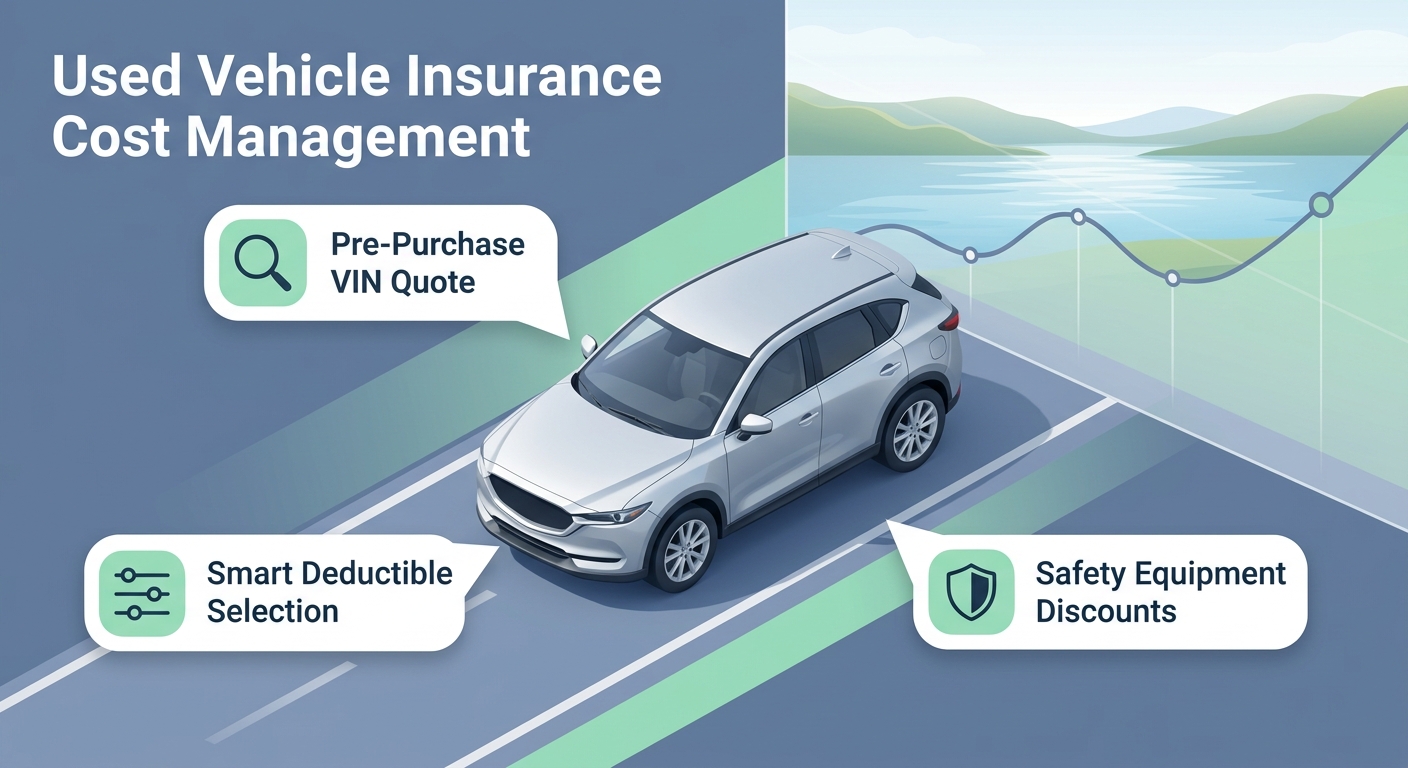
To prevent used car insurance premiums from spiking after purchase, compare rate quotes from multiple insurers before signing, adjust collision and comprehensive deductibles to match the vehicle’s actual market value, and verify that all built-in safety equipment qualifies for policy discounts. Selecting a vehicle with lower repair costs and strong safety ratings keeps monthly premiums steady over the lifetime of ownership.
Securing rate quotes using the vehicle identification number (VIN) prior to finalizing your purchase eliminates unexpected rate hikes. Insurance carriers calculate premiums based on loss history, local repair rates, theft statistics, and replacement part costs. A late-model pre-owned truck or SUV equipped with modern driver-assist technology often qualifies for active safety equipment discounts that help offset standard policy adjustments.
Managing coverage levels as a vehicle ages is another practical strategy to control ownership expenses. Raising collision and comprehensive deductibles from $250 to $500 or $1,000 can lower annual premiums substantially. For older vehicles where annual insurance costs approach a significant percentage of the vehicle’s overall cash value, re-evaluating physical damage coverage ensures you are not over-insuring the asset.
Maintaining a clean driving record and bundling auto coverage with home or renters insurance provides ongoing rate stability. If you are currently evaluating your options between pre-owned choices and our new-vehicle inventory, comparing VIN-specific insurance quotes beforehand gives you a complete picture of total monthly operating costs. Drivers navigating lakeside routes around Guntersville can easily coordinate vehicle inquiries by visiting our dealership showroom or giving our team a quick call to review complete vehicle histories.
Table of Contents
- What Critical Features and ADAS Tech Should You Inspect Before Buying a Used Car?
- What Components Must a Professional Pre-Purchase Mechanical Inspection Cover?
- How Do You Check for Open Safety Recalls and Who Pays for Repairs?
- How Does Routine Maintenance Protect Your Used Vehicle’s Long-Term Value?
- Common Post-Purchase Questions About Used Car Upkeep and Safety
- Taking the Next Step with Your Used Vehicle at Chevrolet
What Critical Features and ADAS Tech Should You Inspect Before Buying a Used Car?
Evaluating advanced driver assistance systems (ADAS) and physical condition requires testing active safety sensors, inspecting body panel alignment, checking tire tread wear, and confirming electrical functionality during a thorough test drive. Verifying that warning lights illuminate and turn off correctly during startup ensures the onboard diagnostic systems are fully operational.
Active safety equipment—such as Forward Collision Alert, Lane Keep Assist, and Side Blind Zone Alert—relies on windshield cameras and bumper radar sensors. On a test drive, observe whether visual or audible alerts trigger properly when changing lanes or trailing traffic. If dashboard warning indicators remain illuminated after engine startup, the vehicle may require sensor recalibration or system repair.
Physical exterior checks reveal critical details about how a vehicle was maintained by its previous owner:
- Body Panel Gaps: Inspect the seams between doors, fenders, trunk lids, and hood lines to confirm uniform spacing. Uneven gaps or mismatched paint shades often signal prior body repairs.
- Tire Tread Depth and Wear: Check tread depth across the entire width of all four tires. Uneven edge wear typically points to wheel misalignment or worn suspension bushings.
- Cabin Electronics and Climate Control: Switch the air conditioning to maximum cool and verify that strong cold airflow begins within a couple of minutes while listening for unusual compressor noises under the hood.
Shoppers comparing options in our pre-owned vehicle selection can evaluate models that have already undergone initial quality checks. For added confidence on daily commutes along the Sand Mountain plateau near Albertville, exploring our certified pre-owned lineup provides vehicles backed by multi-point mechanical standards.
What Components Must a Professional Pre-Purchase Mechanical Inspection Cover?
A comprehensive pre-purchase mechanical inspection must evaluate the engine, transmission, braking system, steering, suspension, exhaust, and electrical architecture while running a diagnostic scan for pending trouble codes. Having a certified technician inspect these core assemblies uncovers hidden mechanical wear before ownership transfer occurs.
When walking buyers through pre-owned models, our service advisors often recommend paying close attention to undercarriage condition and diagnostic fault codes, as a clean visual appearance on top does not always guarantee leak-free mechanicals underneath. A lift inspection allows a technician to check CV boots, shock absorbers, ball joints, and brake rotor surfaces for premature wear or fluid seepage.
Key components covered during a professional inspection include:
- Engine and Transmission: Scanning for historic diagnostic trouble codes, checking engine oil clarity, inspecting drive belts, and evaluating smooth gear engagement under load.
- Brakes and Suspension: Measuring brake pad friction material thickness (noting when pads drop to 2 mm or lower) and checking struts for hydraulic fluid leaks.
- Structural Frame Check: Examining lower frame rails, subframes, and suspension mounting points for fresh welding marks, buckling, or severe rust.
When preparing a pre-owned truck like a 2026 Silverado 1500 LT Trail Boss for demanding agricultural or towing work near Crossville, verifying mechanical integrity upfront prevents unscheduled downtime. Owners can easily book a service appointment online with our factory-trained technicians or customize their truck through official GM accessories to suit daily work demands.
How Do You Check for Open Safety Recalls and Who Pays for Repairs?
You can check for open safety recalls by entering the vehicle’s 17-digit Vehicle Identification Number (VIN) into an official recall lookup tool, and the vehicle manufacturer pays the full cost of all recall repairs at an authorized dealership. Safety recalls do not expire and remain active until the designated repair is completed by certified technicians.
Federal regulations require auto manufacturers to fix safety-related defects on vehicles at no charge to the owner, provided the vehicle falls within 15 years of its original purchase date. Repairs must be performed using genuine factory components at an authorized franchise dealership. If a pre-owned vehicle is purchased with an uncompleted recall, scheduling the service at our dealership resolves the open status without out-of-pocket expense.
In addition to safety recall coverage, late-model pre-owned Chevrolet vehicles benefit from manufacturer-backed protection and emergency assistance options:
- Factory Warranty Coverage: Chevrolet Certified Pre-Owned models feature a 6-year/100,000-mile powertrain limited warranty measured from the original in-service date, alongside a 12-month/12,000-mile bumper-to-bumper limited warranty with a $0 deductible.
- Chevrolet Roadside Assistance: Included coverage provides towing, flat tire changing, jump-starts, and lock-out assistance from brand-trained specialists. Owners can connect directly with Chevrolet Roadside Assistance at 1-800-243-8872 for immediate emergency support.
- Genuine Replacement Parts: Repairs conducted at our authorized service center utilize exact-fit components available through our official GM parts portal to maintain structural integrity.
How Does Routine Maintenance Protect Your Used Vehicle’s Long-Term Value?
Adhering to factory maintenance schedules protects a used vehicle’s resale value by preventing fluid breakdown, minimizing powertrain wear, and establishing a documented service history that future buyers value. Routine maintenance performed at regular mileage intervals keeps mechanical systems operating within manufacturer specifications.
Modern engine designs rely on precise lubrication schedules. For late-model Chevrolet trucks and SUVs, factory guidelines specify dexos approved 0W-20 full-synthetic oil for most EcoTec3 gasoline engines. The vehicle’s Oil Life Monitoring System alerts drivers when service is needed, typically calling for an engine oil and filter change, tire rotation, and brake inspection every 7,500 miles or 12 months under normal driving conditions.
Essential routine maintenance milestones include:
- Every 7,500 Miles: Rotate all four tires to ensure even tread wear and visually inspect brake pad thickness and rotor condition.
- Every 22,500 Miles: Replace the cabin air filter to maintain clean interior ventilation and air conditioning efficiency.
- Every 45,000 Miles: Perform brake fluid exchange and service transmission fluid under severe operating conditions such as frequent towing.
- At 150,000 Miles: Drain and flush engine cooling systems with fresh DEX-COOL coolant.
Keeping up with scheduled care ensures your vehicle retains strong market appeal when you eventually decide to upgrade. When you are ready to evaluate your vehicle’s current equity, you can value your trade-in online to receive an estimate based on current regional market conditions.
Common Post-Purchase Questions About Used Car Upkeep and Safety
Q: How soon after buying a used vehicle should I schedule its first oil change?
If the previous owner or selling party cannot provide clear documentation of recent maintenance, scheduling an oil change within the first 1,000 miles establishes a fresh baseline. Modern Chevrolet models rely on dexos-approved 0W-20 full-synthetic oil with standard change intervals of 5,000 to 7,500 miles guided by the Oil Life Monitoring System. Establishing a regular routine immediately protects internal engine components from premature wear.
Q: What should I do if a dashboard warning light turns on shortly after purchase?
Stop by an authorized service facility to perform a diagnostic fault scan. A diagnostic tool reads stored trouble codes from the engine control module to pinpoint whether the issue stems from an engine sensor, an emission control valve, or an advanced driver assistance camera. Addressing warning lights promptly prevents minor sensor faults from escalating into costly mechanical repairs.
Q: Can I transfer remaining factory warranty coverage when buying a pre-owned vehicle?
Yes, remaining factory warranty coverage automatically transfers to subsequent owners without transfer fees. Certified Pre-Owned Chevrolet vehicles include a 6-year/100,000-mile powertrain limited warranty and a 12-month/12,000-mile bumper-to-bumper limited warranty measured from the original in-service date. Our team can run your vehicle’s VIN to verify exact warranty start dates and remaining coverage limits.
Q: How do financing terms impact my total cost of used vehicle ownership?
Selecting shorter financing terms reduces the total interest paid over the life of the loan, while larger down payments create instant equity that protects against rapid depreciation. When you are ready to secure competitive financing terms tailored to your budget, you can submit a secure credit application online.
Q: How does proper vehicle maintenance support community and dealership initiatives?
Maintaining a safe, reliable vehicle keeps local roads safer for everyone while supporting long-term community relationships. Beyond automotive care, our dealership is actively involved in regional outreach, including supporting breast cancer awareness programs throughout the year. You can learn more about our team and community involvement by visiting our dealership profile page.
Taking the Next Step with Your Used Vehicle at Chevrolet
Maintaining long-term vehicle reliability comes down to proactive inspection habits, timely oil changes, and choosing certified technicians for routine maintenance. Following manufacturer guidelines for fluid changes, tire rotations, and safety system checks preserves performance while protecting your investment for miles to come.
Our factory-trained service team is here to assist with every phase of ownership, from initial pre-purchase inspections to scheduled mileage maintenance. Whether you need a multi-point safety check or guidance on genuine GM parts, we provide straight answers and dependable service tailored to your schedule.
When you are ready to schedule service or explore our vehicle lineup, visit Guntersville Chevrolet at 11982 US, Suite C, Guntersville, AL 35976 or contact our team directly at (256) 578-9170 today.
0 comment(s) so far on How Can You Keep Used Vehicle Insurance Costs From Spiking After Purchase?