


Do Chevy Dealers Provide 4-Wheel Alignment or Just Front-End Alignment?
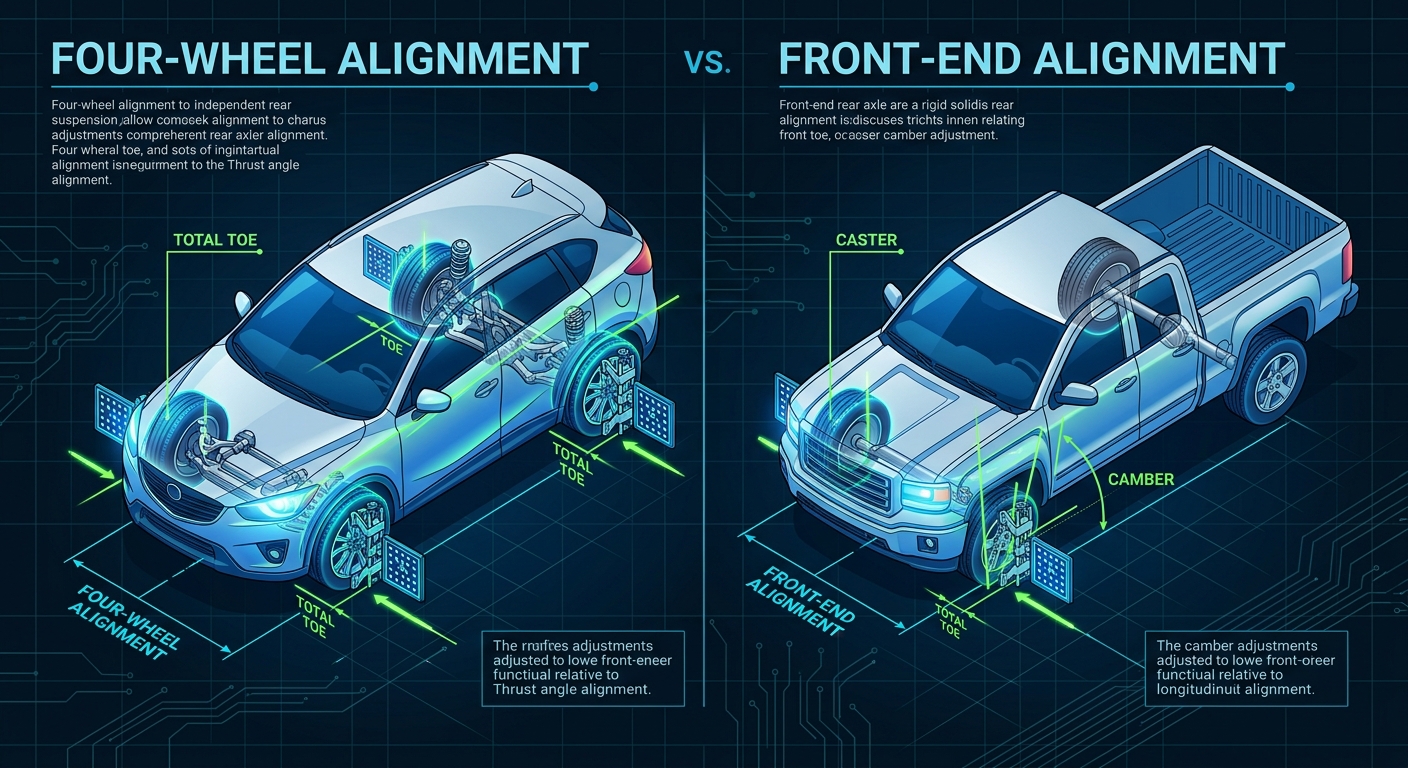
Chevrolet dealerships provide both 4-wheel alignment and front-end alignment, depending on the suspension architecture of your specific model. Vehicles built with independent rear suspension receive a full 4-wheel alignment to adjust all four vehicle corners, whereas trucks and SUVs equipped with a solid rear axle receive a front-end alignment focused on setting the front steering axle.
Understanding which alignment service your Chevrolet requires comes down to how the rear wheels attach to the chassis. Passenger cars, crossover SUVs, and performance models like the Equinox, Traverse, and Corvette feature individual rear suspension links that require routine geometric adjustment. Because both the front and rear tires are subject to individual angle adjustments, technicians align all four wheels to the central thrust line of the vehicle. This process ensures the rear wheels track precisely behind the front wheels, preventing sidewall scrubbing and premature tire replacement.
Full-size trucks and truck-based SUVs like the Silverado 1500 and Tahoe utilize a rigid rear axle assembly. On these vehicles, the rear axle position is fixed directly to the frame, meaning the rear wheels cannot be independently adjusted for tilt or direction. Service for these models focuses entirely on the steering system and front suspension components, aligning the front tires to the existing rear thrust line.
Before any adjustments begin, certified service technicians perform a comprehensive pre-alignment evaluation. This process involves verifying that tire pressures match the vehicle specifications and checking steering linkages, ball joints, and tie rods for mechanical wear. Adjusting wheel angles on worn suspension parts leads to inconsistent steering feel and rapid misalignment. If you suspect your vehicle is due for maintenance, you can check our Guntersville service center location or give our service desk a quick call at (256) 578-9170 to speak directly with an advisor.
Table of Contents
- How Often Should You Get a Chevy Wheel Alignment and What Are the Warning Signs?
- What Is the Difference Between Wheel Alignment and Tire Balancing?
- Front-End vs 4-Wheel Alignment Differences for Chevy Trucks and Towing
- What Does a Chevrolet Wheel Alignment Cost in Guntersville and Are Coupons Available?
- Quick Answers About Chevrolet Wheel Alignment Service
- Keep Your Chevrolet Driving Smoothly with Certified Alignment Service
How Often Should You Get a Chevy Wheel Alignment and What Are the Warning Signs?
A Chevrolet wheel alignment check is recommended at least once a year or every 12,000 miles, with immediate inspection needed after severe impact events like hitting a deep pothole or striking a concrete curb. Regular suspension evaluations preserve driver control, maximize fuel efficiency, and ensure your tires wear evenly across their entire tread surface.
Driver awareness is the best defense against severe tire damage caused by misaligned suspension components. Misalignment gradually alters how the tire contact patch rests against the road surface, leading to noticeable changes in handling long before the tires are completely ruined. Key indicators that your suspension requires professional service include:
- The steering wheel sitting off-center while traveling straight on a flat road.
- The vehicle constantly pulling or drifting toward one side of the lane.
- Uneven tread wear, such as feathering across the tread blocks or excessive wear on the inner or outer tire shoulders.
- A persistent high-speed steering wheel vibration or loose, unresponsive steering feel.
Alignment technicians evaluate three primary suspension angles during a service check: camber, caster, and toe. Camber represents the inward or outward vertical tilt of the tire when viewed directly from the front. Incorrect camber causes heavy shoulder wear on the inside or outside tread edges. Caster is the forward or backward tilt of the steering axis when viewed from the side, which directly influences straight-line stability and steering wheel returnability. Toe describes whether the front edges of the tires point inward toward each other or outward away from each other when viewed from above. Incorrect toe settings create excessive friction, literally dragging the tire rubber sideways along the pavement.
Commuters navigating the elevation changes on the Sand Mountain plateau near Albertville often notice alignment issues first when descending hills or carrying cargo. Rough road surfaces, gravel access trails, and routine curb bumps slowly knock suspension adjusters out of factory limits. Catching these shifts early preserves steering accuracy and keeps your vehicle tracking true. If you are considering an upgrade to a newer model with updated suspension technology, you can browse our new Chevrolet inventory or customize your vehicle using the official GM accessories portal to match your driving habits.
What Is the Difference Between Wheel Alignment and Tire Balancing?
Wheel alignment adjusts the physical angles of your suspension components to ensure the tires meet the road at the correct position, whereas tire balancing distributes weight evenly around the tire and wheel assembly to prevent high-speed shaking. While both services protect your tires and preserve ride comfort, they address entirely different mechanical issues.
Alignment focuses on geometric alignment relative to the chassis and steering wheel position. When your suspension angles slip out of tolerance, the tires fight against each other rather than rolling smoothly forward. This friction leads to uneven tread wear patterns and forces the driver to maintain constant steering correction to keep the vehicle in a straight line. Alignment service involves adjusting tie-rod ends, control arm eccentrics, and suspension struts using specialized optical measurement machines.
Tire balancing addresses mass distribution within the rotating wheel assembly. Manufacturing variations in rubber density and small weight differences in steel or aluminum rims create light and heavy spots across the wheel. At highway speeds, an unbalanced tire generates centrifugal force that manifests as an annoying vibration through the steering wheel, floorboards, or driver seat. Technicians balance tires by mounting the assembly on a high-speed spin-balancing machine that identifies weight imbalances, then attaching small lead free counterweights to the wheel rim.
Knowing which symptom your vehicle exhibits helps target the proper maintenance service:
| Service Type | Primary Purpose | Key Symptoms Addressed | Typical Service Action |
|---|---|---|---|
| Wheel Alignment | Adjust suspension geometric angles (camber, caster, toe) | Vehicle drifting/pulling, off-center steering wheel, uneven tread wear | Mechanical adjustment of control arms, struts, and tie rods |
| Tire Balancing | Equalize weight distribution across the tire/wheel assembly | Steering wheel vibration at highway speeds, hopping feel, spotty tread wear | Spin-testing wheel assembly and applying counterweights |
Combining routine wheel alignments with periodic tire balancing at every oil change or tire rotation ensures maximum tread life and smooth operation. When maintaining pre-owned vehicles, staying current on suspension adjustments prevents premature component fatigue. If your vehicle shows signs of steering drift or wheel vibration, take a moment to schedule a service appointment online or take a look through our current used inventory if you are contemplating a trade-in.
Front-End vs 4-Wheel Alignment Differences for Chevy Trucks and Towing
Chevrolet trucks with solid rear axles typically require front-end alignments, whereas models with independent suspension benefit from 4-wheel alignments for optimal towing performance. For truck owners who haul equipment or tow trailers, maintaining exact suspension geometry on the front axle is essential for directional control and braking response.
Full-size trucks like the 2026 Silverado 1500 LT Trail Boss rely on a heavy-duty front suspension paired with a solid rear axle. When hauling heavy payloads or towing a boat trailer, the rear frame compresses, shifting weight away from the front tires. This weight transfer subtly alters the front caster and toe angles. If the front alignment is misaligned before a heavy load is attached, the dynamic weight shift amplifies steering instability, causing the truck to feel light or wander across lane markings.
Proper alignment on towing rigs directly supports vehicle control and safety systems. Chevrolet models equipped with modern electronic stability control and integrated trailer sway technology rely on accurate steering angle sensor inputs. If your steering wheel is offset due to incorrect toe adjustments, the vehicle’s onboard computers may receive conflicting signals regarding driver steering intent versus actual vehicle path, potentially delaying stability interventions when gusty winds hit your trailer.
Agricultural operators hauling machinery across rural fields near Crossville put exceptional stress on front ball joints, pitman arms, and tie-rod ends. Routine visual inspections of undercarriage hardware ensure that heavy tongue weights do not turn minor steering play into severe tire scrubbing. Setting correct alignment tolerances gives you confidence whether pulling a utility trailer down rural back roads or hauling heavy cargo across highways. If you are planning to upgrade your current towing vehicle, you can value your trade online to see how your current truck fits into a new purchase plan.
What Does a Chevrolet Wheel Alignment Cost in Guntersville and Are Coupons Available?
A standard Chevrolet wheel alignment costs between $100 and $175 for a complete 4-wheel alignment and between $50 and $100 for a front-end alignment, with dealership service specials routinely available to lower out-of-pocket expenses. Investing in timely alignment care avoids the far greater expense of replacing prematurely worn tires or damaged suspension components.
The exact price of alignment service varies based on vehicle driveline, suspension complexity, and whether driver-assist recalibrations are required. Modern Chevrolet vehicles equipped with Lane Keep Assist or Forward Collision Alert require optical camera and sensor recalibration following a suspension adjustment to ensure electronic safety systems read road lines accurately. Chevrolet certified service departments provide clear up-front estimates that outline required labor and mechanical checks.
Vehicle owners can easily manage routine service expenses by taking advantage of dealer promotions and brand reward programs:
- Checking monthly dealer service specials for dedicated alignment discounts and seasonal maintenance bundles.
- Enrolling in Chevrolet MyRewards to earn points on every service visit, which can be applied directly toward future maintenance or GM parts.
- Combining alignment checks with routine tire rotations to lower overall shop visit counts.
- Checking for tire manufacturer rebate programs that offer alignment discounts with the purchase of a new set of tires.
Maintaining proper suspension alignment saves money at the gas pump as well. When tires are misaligned, they drag against the road surface rather than rolling freely, increasing rolling resistance and forcing the engine to burn more fuel to maintain highway speeds. Correcting minor alignment drag restores baseline fuel efficiency, paying back a portion of the service cost over thousands of miles of driving. When planning vehicle upgrades or budgeting for seasonal repairs, buyers can utilize an online credit application to streamline administrative steps before visiting the showroom.
Quick Answers About Chevrolet Wheel Alignment Service
Q: How long does a professional Chevrolet alignment take?
A standard Chevrolet wheel alignment typically takes between 60 and 90 minutes to complete. The service includes a preliminary suspension inspection, mounting laser measurement targets to all four wheels, adjusting mechanical control links to factory specifications, and performing a road test. Service duration may increase if frozen adjustment bolts require heating or if onboard driver-assist sensors require optical recalibration following steering angle adjustments.
Q: Does a Chevrolet wheel alignment include tire balancing?
Wheel alignment and tire balancing are distinct service procedures and are not automatically combined. Alignment adjusts suspension angles to ensure correct tire contact with the road, while balancing redistributes weight around the tire rim to prevent wheel vibration. Service technicians evaluate both systems during routine vehicle inspections and can perform tire balancing alongside an alignment if high-speed vibration or uneven tread spot wear is present.
Q: Can I check my Chevy wheel alignment at home?
You can perform basic visual checks at home, such as inspecting tread depth across the tire surface or verifying that the steering wheel sits straight on flat driveways. Precise wheel alignment adjustments require specialized computerized alignment racks, calibrated optical sensors, and vehicle-specific geometric database software. Professional alignment equipment measures angles down to fractions of a degree, which cannot be duplicated accurately with manual home measurement tools.
Q: Does Chevrolet MyRewards cover alignment costs?
Chevrolet MyRewards members can earn and redeem reward points for certified service maintenance, including front-end and 4-wheel alignments. Points accumulated through vehicle purchases, enrolled service visits, or GM accessories purchases can be applied directly toward your total service invoice at participating dealership service centers.
Q: What is the main difference between camber, caster, and toe angles?
Camber is the inward or outward vertical tilt of the tire when viewed from the front, controlling cornering grip and shoulder tread wear. Caster is the forward or backward tilt of the steering axis when viewed from the side, governing straight-line stability and steering returnability. Toe is the inward or outward angle of the tires relative to the vehicle centerline when viewed from above, directly affecting tire drag and directional steering response.
If you are interested in supporting local outreach programs while researching vehicle maintenance options, you can learn about our community breast cancer awareness initiative or learn more about our team and dealership history. For DIY enthusiasts performing basic maintenance, you can also order genuine GM parts online to ensure proper component fitment.
Keep Your Chevrolet Driving Smoothly with Certified Alignment Service
Maintaining precise wheel alignment protects your tire investment, preserves factory steering responsiveness, and keeps your Chevrolet performing safely under all load conditions. Whether navigating daily commutes or hauling recreational trailers, routine alignment checks prevent costly tread wear and keep your vehicle operating efficiently.
Our factory-trained technicians at Guntersville Chevrolet use advanced diagnostic racks and specialized GM procedures to align your vehicle to exact factory tolerances. If your vehicle pulls to one side, exhibits uneven tread wear, or is due for routine inspection, take the next step to keep your Chevrolet driving like new. You can find our dealership address on the map, call our service team directly at (256) 578-9170 to reserve a time slot, or explore our certified pre-owned lineup today.
0 comment(s) so far on Do Chevy Dealers Provide 4-Wheel Alignment or Just Front-End Alignment?