


What Are the Common Symptoms of Front-End Misalignment on a Chevy Silverado?
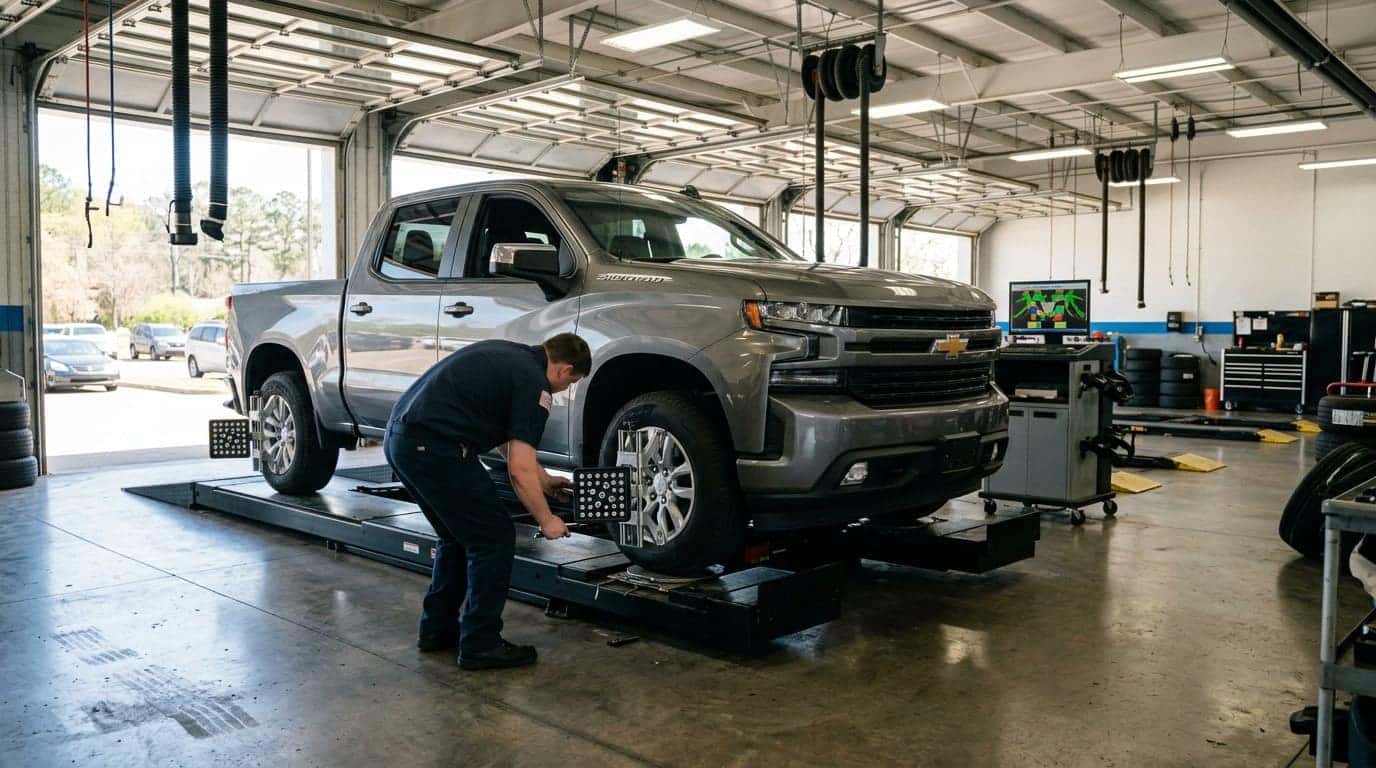
Common symptoms of front-end misalignment on a Chevy Silverado include uneven or feather-edged tire tread wear, a steering wheel that sits off-center while driving straight, persistent pulling or drifting to one side of the road, and steering wheel vibration at highway speeds. Addressing these symptoms promptly restores factory handling precision, prevents premature tire destruction, and keeps electronic chassis controls working accurately.
When front-end suspension angles drift out of factory specification, your truck communicates the issue through mechanical feedback and abnormal tire wear patterns. Front-end alignment relies on three primary measurements: toe, camber, and caster. On full-size trucks like the 2026 Silverado 1500 LT Trail Boss or the anticipated 2027 Silverado 1500, front suspension geometry bears significant loads during daily driving, heavy payload transport, and trailering up to 13,700 pounds.
Analyzing tire wear provides the quickest visual diagnostic for alignment problems:
– Feathered tread edges: Typically indicates incorrect toe alignment, causing the tire to scrub sideways across the road surface.
– One-sided shoulder wear: Points to excessive camber, where the top of the tire tilts too far inward or outward relative to vertical.
– Cupping or scalloped dips across the tread: Often signals worn shock absorbers, uncorrected dynamic toe settings, or imbalanced wheel assemblies.
Physical feedback through the steering wheel is equally telling. If you must keep the steering wheel turned several degrees off-center to maintain a straight line down open Alabama highways, your wheel alignment and steering linkage zero-point are out of sync. Left unchecked, improper suspension angles put uneven strain on lower ball joints, tie rod ends, and wheel bearings. For truck owners operating near agricultural sites around Crossville, regular travel across uneven farm lanes and gravel roads accelerates suspension wear, making periodic alignment inspections essential for maintaining ride quality and steering stability.
If your vehicle exhibits any of these handling warning signs, schedule a diagnostic check at our Guntersville location or give our service desk a quick call to consult with our factory-trained technicians.
Table of Contents
- How Do You Reset the Steering Angle Sensor and Center the Steering Wheel on a Silverado?
- What Causes Highway Speed Steering Vibration and Vehicle Pulling in a Silverado?
- Do You Need Aftermarket Upper Control Arms When Leveling a Chevy Silverado?
- How Does Silverado IFS Alignment Stability Compare to Ram 1500 Suspension Durability?
- How Can You Check for Active Recalls or TSBs Regarding Silverado Steering Issues?
- Frequently Asked Questions About Silverado Steering and Alignment
- Schedule Your Silverado Steering and Alignment Inspection
How Do You Reset the Steering Angle Sensor and Center the Steering Wheel on a Silverado?
Centering the steering wheel on a Chevy Silverado requires setting mechanical toe via equal adjustments on left and right tie rod sleeves while keeping the steering wheel straight, followed by executing an electronic Steering Angle Sensor calibration reset with a factory-compatible OBD-II diagnostic scan tool.
Modern Chevrolet pickup trucks utilize an electric power-assisted rack-and-pinion steering system integrated with StabiliTrak electronic stability control. The Steering Angle Sensor (SAS) monitors the precise rotational angle of the steering column. If a technician adjusts wheel alignment mechanics without resetting the electronic sensor, or if the steering wheel was recentered manually without an electronic recalibration, a zero-point discrepancy occurs between the physical wheel position and the sensor data.
When the physical steering position and sensor readings disagree by more than a few degrees while traveling in a straight line, the chassis control module may interpret the data as a continuous skid or lateral slide. This mismatch frequently illuminates the StabiliTrak warning light, disables traction control, or causes unexpected subtle brake applications as the safety system attempts to correct a non-existent drift.
Resetting the sensor follows a clear technical process:
1. Place the truck on a level surface or alignment rack with front tires pointing dead straight.
2. Center the physical steering wheel and secure it in position using a steering wheel holder.
3. Perform mechanical tie rod adjustments to bring front toe angles within factory tolerance.
4. Connect an advanced diagnostic scan tool to the OBD-II port beneath the dash.
5. Access the Electronic Power Steering or StabiliTrak control module menu.
6. Select the Steering Angle Sensor reset or calibration function to clear previously stored learned values and write the current position as the new absolute zero point.
Whether you drive a brand-new model or are considering a dependable option from our pre-owned truck inventory, maintaining precise sensor calibration keeps driver-assist features and stability controls functioning as engineered. For drivers adding aftermarket equipment, exploring options through the genuine GM accessories catalog can help enhance capability without compromising factory suspension calibration.
What Causes Highway Speed Steering Vibration and Vehicle Pulling in a Silverado?
Highway speed steering wheel vibration and pulling in a Silverado are primarily caused by dynamic tire imbalance, uneven tire wear patterns, worn tie rod ends or steering rack bushings, or uncalibrated wheel alignment angles that shift under load.
A high-speed vibration felt through the steering column—often occurring between 55 mph and 70 mph—most commonly points to front wheel and tire imbalance. Heavy-duty truck tires can lose wheel balance weights over rough terrain or accumulate uneven mud deposits on the inner rim barrel. However, if the vibration is accompanied by a continuous side-to-side shimmy or a vehicle pull, suspension component wear or alignment drift is usually present.
Vehicle pulling occurs when suspension geometry forces the truck off a straight line:
– Caster split: If caster angles differ significantly between the left and right front wheels, the truck will pull toward the side with less positive caster.
– Camber variation: Excessive camber differences cause the vehicle to drift toward the side with more positive camber.
– Uneven tire pressure or radial tire pull: Internal tire belt shifts or mismatched inflation pressures create rolling resistance differences that pull the truck sideways.
– Worn steering components: Loose inner or outer tie rod ends allow dynamic toe movement, causing the front wheels to wander under acceleration or braking.
Power choices across the lineup demand consistent front-end health. Engine options announced for the upcoming 2027 Silverado 1500—including the enhanced TurboMax producing 350 hp and 455 lb-ft of torque, the 3.0-liter Duramax turbo-diesel with 495 lb-ft of torque, the new 5.7-liter V8 delivering 402 hp, and the new 6.6-liter V8 outputting 481 hp—deliver high torque loads to the drive wheels. That power transfer highlights any minor front suspension looseness or wheel alignment defect.
Drivers cross-shopping models in our new Silverado 1500 lineup or evaluating our certified pre-owned inventory can rely on our team for complete chassis checks. Beyond maintaining trucks, our dealership proudly supports community awareness initiatives throughout the region.
Do You Need Aftermarket Upper Control Arms When Leveling a Chevy Silverado?
Installing a leveling kit over two inches on a Chevy Silverado requires aftermarket upper control arms to restore factory ball joint operating angles, maintain correct suspension travel, and allow alignment technicians to hit proper caster and camber specs.
Leveling kits raise the front suspension to equalize vehicle height with the rear bed, giving the truck an aggressive stance and extra ground clearance for larger off-road tires. However, lifting the front strut assembly changes the resting position of the independent front suspension. On factory control arms, a lift over two inches forces the upper ball joint to operate at an extreme downward angle near the limit of its mechanical articulation.
Operating at severe angles causes accelerated ball joint boot wear, premature joint failure, and risk of the upper control arm contacting the frame bump stop during suspension rebound. Furthermore, factory control arm geometry limits the range of camber and caster adjustment available at the lower control arm alignment cams. Without corrected upper control arm geometry, technicians often cannot eliminate excessive positive camber or correct caster angles after leveling.
Aftermarket upper control arms engineered for leveled trucks resolve these issues by incorporating:
– Repositioned ball joint housings that sit level at raised ride heights.
– Heavy-duty, greasable ball joints or uniball bearings built for increased articulation.
– Re-engineered arm lengths that restore lost caster and clear factory frame mounts.
Our advisors often notice truck owners bring in a Silverado after installing a leveling kit on their own, only to find the steering feels light or erratic at highway speeds because factory control arms could not reach correct alignment settings. For truck owners navigating mountain foothill terrain around Rainsville, having corrected suspension geometry ensures predictable steering feedback when hauling trailers on steep inclines or descending gravel grades.
If you are planning suspension upgrades or upgrading your vehicle, our team can help you evaluate options and use our online trade-in appraisal tool to plan your next truck purchase transparently.
How Does Silverado IFS Alignment Stability Compare to Ram 1500 Suspension Durability?
Chevrolet Silverado independent front suspension delivers superior long-term alignment stability compared to the Ram 1500 by utilizing robust forged control arms and direct coil-over-shock geometry that hold caster and camber angles tight under heavy payload and trailering.
Both trucks utilize independent front suspension (IFS) setups designed to balance ride comfort with truck capability. However, structural differences in component material and geometry affect how well each vehicle maintains alignment settings over years of hard work.
| Suspension Component / Feature | Chevrolet Silverado 1500 IFS | Ram 1500 Front Suspension |
|---|---|---|
| Control Arm Material | Forged steel or forged aluminum (trim dependent) | Stamped steel or cast composite arms |
| Front Spring Design | Independent coil-over-shock assemblies | Coil spring with twin-tube damper |
| Steering System | Electric power-assisted rack-and-pinion | Electric power steering rack |
| Alignment Retaining Hardware | Heavy-duty eccentric cam bolts at lower arm pivots | Standard adjustment cam hardware |
| Max Available Towing Capacity | Up to 13,700 pounds (configuration dependent) | Up to 12,750 pounds (configuration dependent) |
The Silverado independent front suspension uses thick forged control arm structures that resist flexing when entering deep ruts or supporting heavy front axle loads. Lower control arm pivot points feature robust eccentric cam guides that lock alignment settings securely in place. By contrast, Ram 1500 front suspension setups place high wear demands on upper ball joints and rubber control arm bushings, which can lead to faster alignment drift and inner tire edge wear when frequently carrying heavy bed loads.
Maintaining precise wheel alignment ensures your truck handles predictably whether empty or fully loaded. When you are ready to explore your next truck purchase, you can complete our secure online credit application from home to begin the purchasing process.
How Can You Check for Active Recalls or TSBs Regarding Silverado Steering Issues?
Silverado owners can check for active steering recalls or Technical Service Bulletins by entering their vehicle’s 17-digit Vehicle Identification Number into the official NHTSA recall database or GM Owner Center portal.
A safety recall is issued when a manufacturer or federal safety agency identifies a defect that compromises vehicle safety, requiring free repair by an authorized dealership. A Technical Service Bulletin (TSB), by contrast, is a diagnostic and repair guide provided by General Motors to dealership service departments detailing recommended procedures for specific owner complaints or software updates.
To verify open recalls or service bulletins for your truck:
1. Locate your 17-digit Vehicle Identification Number (VIN) stamped on the driver-side corner of the dashboard (visible through the windshield) or on the driver door jamb sticker.
2. Visit the official National Highway Traffic Safety Administration (NHTSA) recall lookup tool or the GM Owner Center website.
3. Enter the VIN to display any outstanding safety recalls related to steering racks, intermediate shafts, or electronic power steering software.
4. Contact an authorized Chevrolet service department to review technical service bulletins matching your specific steering symptoms.
For current models or outgoing options like the 2026 Silverado 1500, factory software updates frequently refine steering assistance algorithms or StabiliTrak response parameters. Keeping steering control modules updated prevents false sensor codes and ensures smooth electric power steering operation. When replacement components are required, our service department sources direct from the official GM parts catalog to ensure exact factory fitment and durability.
Frequently Asked Questions About Silverado Steering and Alignment
Q: How often should you get an alignment on a Chevy Silverado?
You should check your Chevy Silverado alignment every 12,000 miles or once a year, as well as whenever you install new tires, replace suspension components, or notice symptoms like steering wheel off-center or uneven tire wear. Regular checks prevent premature tire scrubbing and keep electronic stability systems properly calibrated.
Q: Can a bad alignment trigger the StabiliTrak warning light?
Yes, a significant front-end misalignment can trigger the StabiliTrak warning light. If your steering wheel is off-center while driving straight, the Steering Angle Sensor sends data indicating a turn, while wheel speed sensors indicate straight travel. This mismatch causes the chassis control module to log a fault code and temporarily disable stability assistance.
Q: What is the difference between wheel balancing and front-end alignment?
Wheel balancing corrects weight imbalances in the tire and wheel assembly to eliminate high-speed steering wheel vibration. Front-end alignment adjusts the physical angles of the suspension components—toe, camber, and caster—so the tires roll parallel to each other and perpendicular to the road surface. Both services are necessary for smooth handling and long tire life.
Q: Will installing a leveling kit void my Silverado warranty?
Installing an aftermarket leveling kit does not automatically void your entire vehicle warranty, but damage directly caused by the kit or improperly angled suspension components will not be covered under factory warranty terms. Choosing quality components and ensuring correct alignment after installation helps safeguard vehicle durability.
Q: Why does my Silverado pull to the right even after an alignment?
A truck may pull right after an alignment due to radial tire pull from uneven tread wear, uncalibrated Steering Angle Sensor zero points, uneven tire pressures, or natural road crown designed to drain rainwater. Swapping front tires side-to-side or performing an electronic sensor reset typically identifies and resolves the issue.
Schedule Your Silverado Steering and Alignment Inspection
Maintaining accurate steering geometry and electronic sensor calibration is key to preserving the ride quality, tire lifespan, and towing performance of your Chevy Silverado. Whether you are dealing with highway vibration, an off-center steering wheel, or recent suspension modifications, professional diagnostic care keeps your truck working reliably.
Our service center features factory-trained technicians equipped with digital alignment equipment and GM diagnostic tools to calibrate electric power steering systems and chassis control modules correctly. To set up your service visit or speak with our service team directly, stop by our showroom address, call (256) 578-9170, or reserve your appointment online using our convenient online service scheduler today.
0 comment(s) so far on What Are the Common Symptoms of Front-End Misalignment on a Chevy Silverado?