


Are There Places That Offer Free Tire Rotations?
Beyond standalone tire shops that include lifetime rotation guarantees with new tire sales, certified dealership service departments often run seasonal maintenance specials or maintenance programs that cover basic tire care. When you bring your vehicle in for routine care, technical staff check tread depth, adjust inflation pressures, and rotate tires to ensure even wear across all four corners without charging separate labor fees for the rotation itself.
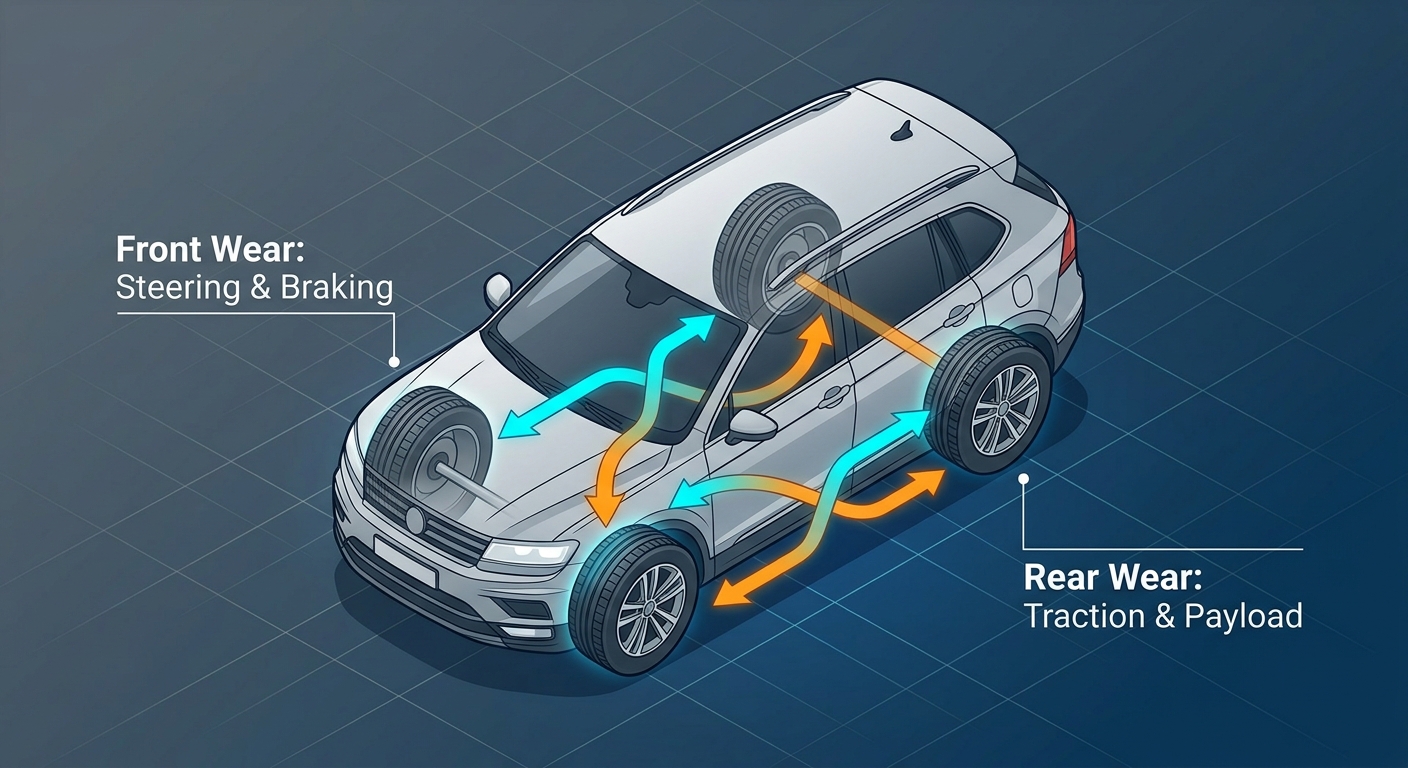
For truck and SUV owners who drive frequently around local waterways or haul heavy cargo near Guntersville, regular tire care is crucial. Front tires endure greater cornering stress and weight transfer during stopping, while rear tires support payload weight. Utilizing complimentary rotation offers through your local service provider helps protect your tire investment without adding unnecessary expenses to your vehicle maintenance budget.
If you want to verify current service specials or speak directly with our certified technicians, feel free to give our team (256) 578-9170 a quick call. You can also drop by our Guntersville service department to review available service options and ensure your tires are wearing evenly.
Table of Contents
- How Does Regular Tire Rotation Extend Tread Life and Improve Mileage?
- What Is the Impact of Regular Tire Rotation on Your Warranty?
- What Tire Rotation Patterns Are Used for Different Drivetrains?
- How Are Directional, Staggered, and Full-Size Spare Tires Rotated?
- Common Questions About Tire Maintenance and Rotation Patterns
- Schedule Expert Tire Service at Guntersville Chevrolet
How Does Regular Tire Rotation Extend Tread Life and Improve Mileage?
Regular tire rotations extend overall tread lifespan by periodically changing the position of each tire on the vehicle, preventing severe local wear patterns from forming on specific tread blocks. By distributing steering, braking, and drive forces evenly across all four tires, proper rotation can increase total tread life by 20 to 30 percent—adding 10,000 miles or more of usable service—while reducing rolling resistance to improve fuel efficiency by 1 to 3 percent.
Front and rear axles subject tires to vastly different mechanical forces during daily operation:
- Front tires absorb steering friction, bear heavy cornering loads, and handle up to 60 percent of total braking force.
- Rear tires maintain straight-line stability and bear static weight from cargo or passengers.
- Drive wheels experience continuous rotational torque from the engine, accelerating rubber abrasion compared to non-drive wheels.
In heavy-duty applications like the 2026 Silverado 1500 LT Trail Boss, the front suspension supports engine weight while steering, whereas the rear axle carries substantial tongue weight when hauling a boat or equipment trailer. Without routine rotation, front tire shoulders scrubbing through sharp turns wear down prematurely, while rear tires develop flat tread centers.
When tread wears down unevenly, irregular rubber surfaces create excess drag against the asphalt. Maintaining flat, uniform tread across all four tires minimizes rolling resistance, allowing your powertrain to propel the vehicle with less effort and lower fuel consumption. If you are considering upgrading your daily drive, feel free to browse our new Chevrolet inventory to compare model capabilities and factory maintenance intervals.
What Is the Impact of Regular Tire Rotation on Your Warranty?
Documented tire rotation at required mileage intervals is often mandatory to keep tire manufacturer treadwear warranties valid and fully enforceable. Major tire manufacturers require regular rotations every 5,000 to 8,000 miles, and failing to present service records showing consistent rotation can result in denied warranty claims if tread wears out before the stated mileage limit.
Tire manufacturer guarantees—such as a 60,000-mile treadwear warranty—are calculated based on ideal, uniform wear across the entire tread pattern. If you submit a warranty claim for tires that worn down prematurely to the minimum safety limit of 2/32 of an inch, inspectors evaluate the tread wear pattern across the tire surface:
- Severe shoulder wear caused by unrotated front steering forces is categorized as mechanical neglect rather than a material defect.
- Uneven tread depth differences between front and rear tires indicate skipped rotations, which forfeits pro-rated replacement credits.
- Keeping digital service receipts verifying routine rotations preserves your coverage rights if a manufacturing defect causes accelerated wear.
Maintaining documented service history also enhances resale value and vehicle trade-in evaluations. To evaluate your current vehicle’s market position, you can value your trade online prior to your next service appointment, or explore certified pre-owned vehicles that have undergone thorough multi-point tire and mechanical inspections.
What Tire Rotation Patterns Are Used for Different Drivetrains?
Selecting the correct tire rotation pattern depends entirely on whether your vehicle uses front-wheel drive, rear-wheel drive, four-wheel drive, or all-wheel drive. Executing the proper rotation pattern ensures that tires swap drive axles and switch rolling directions, allowing inner and outer tread blocks to balance out wear over time.
Standard rotation patterns include:
- Forward-Cross Pattern (Front-Wheel Drive): Front tires move straight back to the rear axle on the same sides. Rear tires move forward to the front axle and cross sides (rear left moves to front right; rear right moves to front left).
- Rearward-Cross Pattern (Rear-Wheel Drive and Four-Wheel Drive): Rear tires move straight forward to the front axle on the same sides. Front tires move to the rear axle and cross sides (front left moves to rear right; front right moves to rear left).
- X-Pattern (All-Wheel Drive or Alternative Option): All four tires swap diagonally across the vehicle (front left to rear right, front right to rear left).
Forward-Cross (FWD)        Rearward-Cross (RWD/4WD)        X-Pattern (AWD)
 [Front Left] [Front Right]   [Front Left] [Front Right]   [Front Left] [Front Right]
|            |               \          /                 \          /
|            |                \        /                   \        /
|            |                 \      /                     \      /
v            v                  v    v                       v    v
 [Rear Left]  [Rear Right]    [Rear Left]  [Rear Right]    [Rear Left]  [Rear Right]
      \          /                |            |              ^          ^
       \        /                 |            |               \        /
        \      /                  |            |                \      /
         v    v                   v            v                 \    /
 (Rear to Front Cross)         (Front to Rear Cross)         (Diagonal Swaps)
Drivers navigating the rolling terrain and varying road grades of the Sand Mountain plateau near Albertville rely on predictable steering control and braking traction. Using the correct rotation sequence preserves balanced grip across all four corners. If you are looking to purchase a reliable pre-owned truck or sedan, you can check our pre-owned vehicle options and submit a digital credit application online before stopping by.
How Are Directional, Staggered, and Full-Size Spare Tires Rotated?
Specialized tire configurations—including directional tread designs, staggered wheel sizes, and matching full-size spare tires—require modified rotation procedures to prevent severe handling degradation or mechanical wear. Standard cross-rotation patterns cannot be used on these specialized wheel and tire setups.
Directional Tire Rotations
Directional tires feature V-shaped tread grooves designed to sweep water away from the contact patch when rolling in one specific direction. Sidewalls feature molded arrows indicating required forward rotation.
- Directional tires must remain on the same side of the vehicle during rotation.
- Front left swaps directly with rear left; front right swaps directly with rear right.
- Crossing a directional tire to the opposite side forces the tread pattern to run backward, reducing wet weather grip and increasing tire noise.
Staggered Wheel Setup Rotations
Vehicles with staggered fitments feature wider wheels and tires on the rear axle than on the front axle for added acceleration traction.
- Front tires cannot move to the rear axle due to size differences.
- If tires are non-directional, front tires swap side-to-side on the front axle, while rear tires swap side-to-side on the rear axle.
- If staggered tires are also directional, they cannot be rotated unless the tires are dismounted from the wheels and remounted on opposite rims.
Five-Tire Rotations with Full-Size Spares
Vehicles equipped with a matching full-size spare tire can integrate the spare into a five-tire rotation sequence.
- On rear-wheel or four-wheel drive trucks, the spare tire moves into the right rear position.
- The right rear tire moves to the right front, the right front crosses to the left rear, the left rear moves to the left front, and the left front becomes the new spare.
- Five-tire rotations ensure all five tires wear down at identical rates, preventing transfer case strain on 4WD systems if a flat tire occurs.
To check tire fitments or view replacement options for your truck or SUV, you can shop new tires online through our dedicated tire center.
Common Questions About Tire Maintenance and Rotation Patterns
Q: How often should I rotate the tires on my Chevy truck or SUV?
Chevrolet service standards recommend rotating tires every 7,500 miles, which aligns conveniently with regular engine oil change visits. Performing tire rotations at every oil change interval ensures uniform tread wear across steering and drive axles while eliminating the inconvenience of booking separate service visits.
Q: Can skipping tire rotations cause uneven tire wear and vehicle vibrations?
Skipping routine tire rotations leads to cupping, feathering, and uneven shoulder wear across the tread face. As tread wear becomes irregular across the tire surface, it generates noticeable cabin road noise and steering wheel vibrations at highway speeds, ultimately requiring premature tire replacement.
Q: Is an X-pattern tire rotation safe for all passenger cars?
The X-pattern tire rotation is safe and effective for non-directional tires of uniform size across all four wheel positions. However, directional tread designs or staggered front and rear wheel sizes require specialized front-to-back or side-to-side rotation paths to preserve handling safety and tread performance.
Q: Why do front tires wear down faster than rear tires on front-wheel-drive cars?
Front tires on front-wheel-drive vehicles handle engine power transmission, steering input, and the majority of braking forces while supporting up to 60 percent of the total vehicle weight. Without routine rotation, front tire treads wear down roughly twice as fast as rear tire treads.
Q: Will rotating my tires regularly help maintain proper vehicle wheel alignment?
Tire rotation does not align vehicle suspension components, but it prevents minor alignment variations from causing severe, permanent damage to a single tire tread block by evenly distributing wear across all tires. Technicians inspect tread patterns during rotation to spot early signs of alignment misalignment before severe damage occurs.
If you are ready to setup your next service visit, you can schedule a service appointment online, read more about our dealership team, or learn about our community involvement.
Schedule Expert Tire Service at Guntersville Chevrolet
Maintaining consistent tire rotation schedules protects your tire investment, maximizes fuel economy, and keeps factory treadwear warranty protections active. Whether you drive a light truck, a family SUV, or an efficient commuter car, routine tire maintenance ensures predictable traction and stable handling on every road surface.
Our factory-trained technicians at Guntersville Chevrolet bring specialized equipment, precise wheel lug torque protocols, and comprehensive multi-point inspection procedures to every service visit. We inspect tread depth, check inflation pressures, and execute the exact rotation pattern required for your specific drivetrain.
To book your next maintenance visit or inspect genuine upgrades, visit us at 11982 US, Suite C, Guntersville, AL 35976, give our team a call at (256) 578-9170, or browse genuine GM accessories online today.
0 comment(s) so far on Are There Places That Offer Free Tire Rotations?